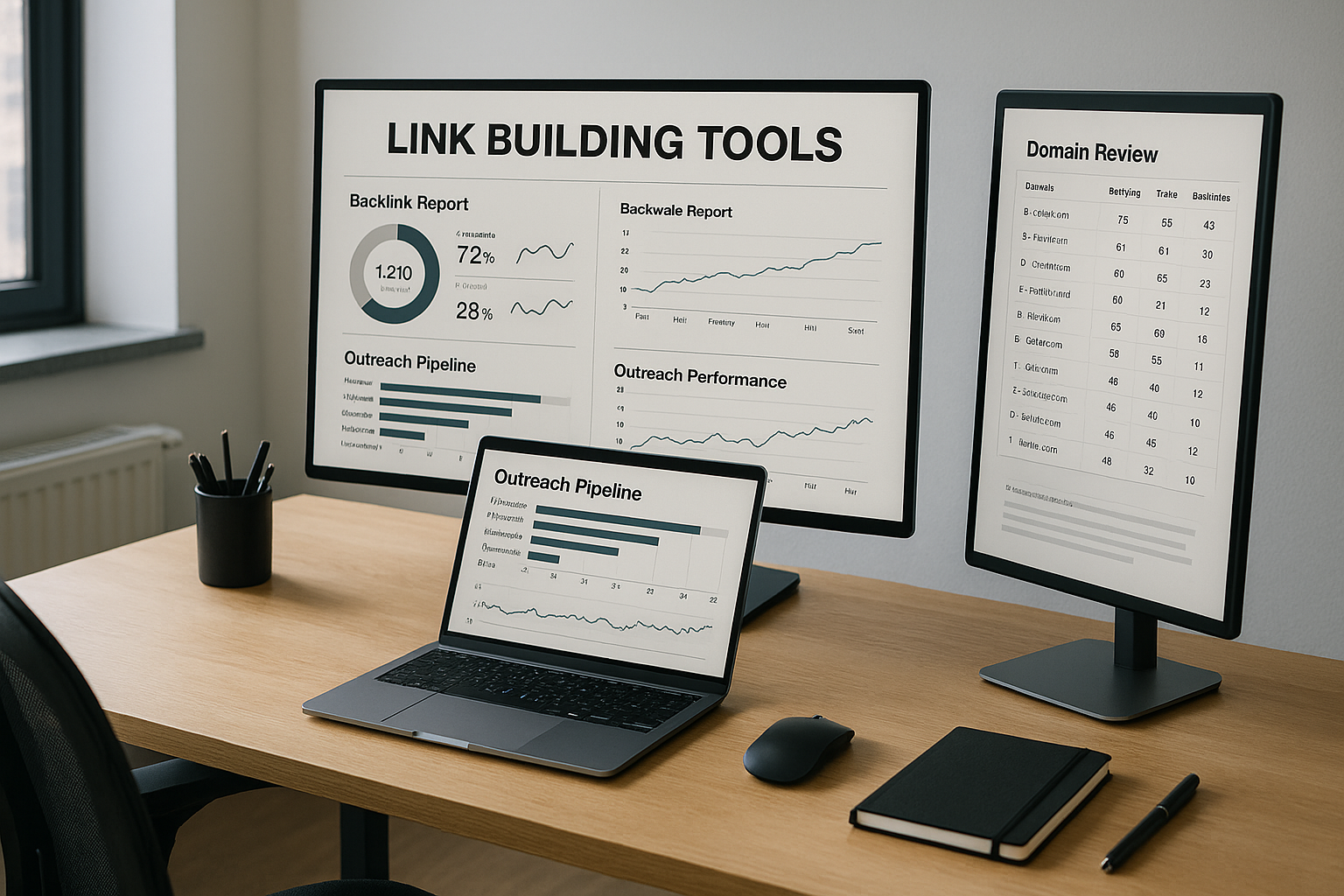

Link building tools are no longer just databases and outreach add-ons. In 2026, they sit at the center of a more disciplined SEO workflow: finding relevant prospects, evaluating site quality, organizing campaigns, monitoring live links, and protecting your backlink profile over time.
The challenge is that many teams still buy tools the wrong way. They choose based on the biggest index, the longest feature list, or the loudest marketing claims. Then they end up with bloated workflows, weak prospect lists, and outreach that creates more noise than value.
The better approach is to treat link building tools as part of a system. Each tool should help your team answer a specific question: Who is worth contacting? What content deserves promotion? Which pages attract links naturally? Which links stayed live? Which placements are improving authority and topical relevance? When you build around those questions, your stack becomes leaner, faster, and far more effective.
In this guide, we will cover the best practices for choosing and using link building tools in 2026, the categories that matter most, the mistakes that still waste budget, and how to build a stack that supports sustainable growth.
Why link building tools matter more in 2026
Search visibility depends on more than raw link volume. Relevance, editorial quality, topical fit, and link placement all matter. That means manual judgment is still essential, but manual work without the right software quickly becomes inefficient.
Modern link building tools help teams do three things well:
- Reduce research time by surfacing websites, pages, and contacts that fit your niche.
- Improve decision quality through metrics, backlink context, page-level analysis, and competitor comparisons.
- Maintain control with workflows for outreach, approvals, reporting, and backlink monitoring.
In practical terms, the right tools help you stop guessing. They make it easier to decide whether a prospect is genuinely valuable, whether a linking page fits your topic, and whether your campaign is building durable authority instead of chasing vanity placements.
What to look for in link building tools
Before comparing brands or building a stack, define the standard each tool must meet. In 2026, the best link building tools are not the ones with the most tabs. They are the ones that improve judgment, speed up execution, and integrate cleanly into your process.
1. Reliable backlink and domain data
Any tool you use for backlink analysis tools or competitor backlink research needs a solid index and useful filtering. You should be able to review:
- Referring domains and pages
- New and lost backlinks
- Anchor text patterns
- Link type and placement context
- Top linked pages
- Historical trends that reveal consistency, not just spikes
The goal is not to chase one metric. It is to understand whether a domain is truly relevant and whether a page can send authority, referral traffic, or editorial trust.
2. Page-level relevance, not just domain-level metrics
One of the most common buying mistakes is overvaluing domain-level authority while ignoring the actual page where the link may appear. A strong domain can still host weak, thin, or off-topic pages. Good link building tools make it easier to assess the page itself, including topic match, internal linking, freshness, indexability, and whether the page appears editorially maintained.
3. Outreach workflow support
Outreach software should help your team stay organized, not encourage bulk, templated email blasts. Look for tools that support:
- Prospect segmentation
- Custom fields and notes
- Relationship history
- Follow-up scheduling
- Status tracking across campaigns
- Clear ownership for each prospect
Strong outreach is closer to business development than email automation. Your tools should reflect that.
4. Monitoring and retention features
Securing a link is only part of the job. Links move, change, or disappear. Backlink monitoring matters because lost placements, changed anchor text, and noindex issues can quietly reduce campaign value. A useful tool should make it easy to track whether links remain live and whether their context still supports your SEO goals.
5. Exporting, reporting, and collaboration
Whether you work in-house or at an agency, reporting should not require endless spreadsheet cleanup. The best tools allow clean exports, fast tagging, and clear reporting views. Collaboration matters too. Editors, SEO leads, PR teams, and account managers should all be able to see campaign status without chasing updates across multiple documents.
The essential categories of link building tools
You do not need every tool category at enterprise depth. But you do need to understand the roles each category plays so you can build a stack with fewer blind spots.
Prospecting tools
Prospecting tools help you find relevant websites, writers, resource pages, journalists, associations, niche blogs, partners, directories, and publications. Their real value lies in filtering. The best prospecting process narrows a large universe down to a shortlist worth a manual review.
Best practice in 2026: start with topical relevance and audience overlap, not authority alone. Build lists around content themes, commercial categories, and intent. A smaller list of closely aligned sites usually outperforms a large list of generic targets.
Backlink analysis tools
These tools are essential for competitive research and opportunity discovery. They show which sites link to your competitors, which content assets attract links, and where gaps exist in your own profile. They also help identify patterns worth replicating, such as resource page links, expert commentary placements, niche directories, tools, studies, and editorial mentions.
Best practice in 2026: analyze link patterns by page type, not only by domain. If a competitor earns links consistently to guides, templates, calculators, or category pages, that is a strategic signal. It tells you where the market sees value.
Outreach software
Outreach tools are the campaign engine. They keep your pipeline visible and help you manage communication at scale. But scale should never mean generic messaging. The point of outreach software is not to send more emails. It is to send better emails more consistently.
Best practice in 2026: use outreach software to personalize intelligently. Segment by vertical, page type, relationship stage, and pitch angle. Then write concise, relevant emails that show why your asset deserves attention.
Digital PR tools
Digital PR tools support media research, journalist monitoring, campaign coordination, and brand mention tracking. They are particularly useful when your link acquisition strategy depends on commentary, launches, data-led content, or timely expert insight.
Best practice in 2026: keep PR and SEO workflows connected. Media visibility is useful, but if your PR team secures coverage without linking opportunities, the SEO impact may remain limited. Shared workflows improve follow-up and link reclamation.
Backlink monitoring tools
Monitoring tools track new, lost, and changed links so you can protect what you have earned. They are also useful for checking whether partner pages remain indexed, whether links become nofollow or sponsored, and whether critical placements are removed during site redesigns or content updates.
Best practice in 2026: monitor strategically. Give higher priority to links pointing to money pages, cornerstone content, and pages that support major rankings. Not every lost link deserves recovery effort.
Anchor text analysis and risk review tools
Anchor text analysis helps you see whether your profile looks balanced. Over-optimized anchor patterns still create unnecessary risk and often signal a campaign that is too narrow or too transactional. A healthy profile usually includes a mix of branded, topical, navigational, and natural language anchors.
Best practice in 2026: review anchor text quarterly, especially after aggressive campaigns or page-level pushes. If the distribution looks forced, broaden your acquisition approach and prioritize editorial context over exact-match anchor control.
Best practices for using link building tools in 2026
Once your stack is in place, the quality of your process matters more than the number of subscriptions on your invoice. These are the working principles that separate efficient teams from noisy ones.
Start with linkable targets, not outreach lists
Most failed campaigns begin with outreach before the target page is ready. Before you build a prospect list, review whether the destination page is truly link-worthy. Ask:
- Is the content more useful than what already exists?
- Does it offer original structure, insight, or utility?
- Would a publisher feel comfortable referencing it?
- Is the page internally linked and commercially relevant?
Link building tools can help you find opportunities, but they cannot compensate for weak assets.
Qualify every prospect manually
Automation can narrow the list, but final approval should still involve a human review. Check the site’s topical fit, publishing standards, outbound link behavior, author transparency, and visible editorial care. A domain with acceptable metrics can still be the wrong target if the site looks thin, neglected, or obviously transactional.
Manual review is where most quality gains happen. This is also where many teams cut corners.
Use competitor backlink research as a map, not a copy list
Competitor backlink research is valuable because it reveals proven link sources and content patterns. But copying competitors too literally creates shallow campaigns. Instead, study the type of coverage they earn and ask what your brand can contribute that is different, sharper, or more useful.
If competitors earn links through resource pages, build a better resource. If they win editorial mentions through commentary, improve your response process. If they attract links to category-led content, strengthen your commercial page quality before outreach.
Separate prospect discovery from relationship management
Many teams use one tool for everything and end up with cluttered records. Prospect discovery and relationship management are different tasks. Discovery is about filtering and qualification. Relationship management is about context, history, and timing.
Even if your software combines both functions, treat them as separate stages in your process. This keeps lists clean and prevents premature outreach.
Track links at the page level
Campaigns are often reported at the domain level because it is easier. But SEO value is created at the page level. Record the exact source URL, target URL, anchor text, link attributes, surrounding context, and date acquired. This makes monitoring, reporting, and troubleshooting far more accurate.
Prioritize editorial fit over raw volume
In 2026, a handful of relevant placements on trusted pages can do more for a brand than a large batch of weak mentions. Use your link building tools to identify sites that genuinely publish for your audience, then invest time in better pitches and stronger assets.
This approach is slower than mass outreach, but it produces a profile that is easier to defend and more likely to support long-term rankings.
A practical framework for choosing the right link building tools
If you are building or rebuilding your stack, use this framework before you subscribe.
| Need | What the tool must do | Common mistake |
|---|---|---|
| Prospecting | Surface relevant websites and pages with strong filtering options | Chasing large lists without topic qualification |
| Backlink research | Show competitor links, top linked pages, new and lost links, and anchor patterns | Relying on one authority metric |
| Outreach | Organize campaigns, ownership, contact history, and follow-ups | Using automation to replace personalization |
| Monitoring | Track live status, attribute changes, and important lost links | Only checking links after traffic drops |
| Reporting | Export cleanly and connect campaign activity to page-level outcomes | Reporting link counts without context |
A good stack covers each need with minimal overlap. More software is not always better. In many cases, one strong backlink platform, one outreach platform, and a disciplined spreadsheet or CRM process are enough.
How different teams should build their stack
Solo consultants and lean teams
Keep the stack simple. You need one dependable backlink research platform, one prospecting workflow, and one lightweight outreach system. Focus on efficiency and clear prioritization. Your advantage is speed of judgment, so avoid tools that create unnecessary process.
In-house SEO teams
In-house teams should emphasize alignment with content, PR, and category owners. The best stack is one that makes approvals, asset selection, and reporting easier across departments. If your tools cannot support collaboration, campaigns will stall regardless of data quality.
Agencies
Agencies need consistency, documentation, and repeatable QA. That usually means stronger templates, clearer prospect scoring, and tighter reporting standards. Agencies also benefit from monitoring systems that prevent lost links from going unnoticed between monthly reviews.
Mistakes to avoid with link building tools
- Buying based on hype: Choose tools based on workflow fit, not brand noise.
- Over-automating outreach: Efficiency matters, but generic pitches hurt response rates and reputation.
- Ignoring page quality: A strong domain does not guarantee a worthwhile linking page.
- Reporting vanity metrics: Link counts alone tell an incomplete story.
- Forgetting retention: Earned links should be monitored, not assumed permanent.
- Using the same pitch everywhere: Different site types require different value propositions.
- Neglecting anchor diversity: Exact-match heavy profiles often reflect poor campaign balance.
Make your link building tools work harder
The best teams do not just use tools to find websites. They use them to improve decisions at every stage: choosing linkable assets, qualifying prospects, shaping outreach, monitoring outcomes, and refining strategy over time.
If you want stronger results from your link building tools, start by tightening your process. Define your standards for relevance, page quality, outreach quality, and reporting. Then make sure every tool in your stack supports those standards instead of distracting from them.
Want a cleaner, more scalable SEO workflow? Explore Rabbit SEO to organize your campaigns, simplify reporting, and keep your team focused on the work that actually drives organic growth.
Conclusion: link building tools should sharpen strategy, not replace it
In 2026, the most effective link building tools are the ones that help you make better strategic decisions, not just faster tactical moves. They should help you discover relevant opportunities, evaluate them with discipline, manage outreach professionally, and protect the links you earn.
If your stack is producing more lists than results, the problem is probably not a missing feature. It is usually a weak process, poor qualification, or unclear standards. Fix those first, and your tools become far more valuable.
The winning approach is simple: choose the right stack, use it with editorial judgment, and build links that make sense for users as well as search. That is how link building tools support durable SEO growth.