
SEO tools are essential to modern link building, but they do not fix a weak process. In fact, the more data you have, the easier it becomes to make confident decisions based on the wrong signals. Teams often buy another platform, add another browser extension, or export another spreadsheet when the real problem is simpler: they are using tools without a clear framework for evaluating opportunities, prioritizing outreach, and validating results.
That matters because link building is not a volume game. It is a relevance, quality, and execution game. The right stack can help you uncover backlink gaps, assess domains, organize prospects, and monitor earned links. The wrong setup can send you toward low-value websites, duplicate outreach, weak anchor text decisions, and reports that look impressive but mean very little.
In this guide, we will look at the most common mistakes marketers make with SEO tools in link building and how to avoid them. If you want better backlinks, cleaner workflows, and reporting that reflects real SEO progress, these are the habits worth fixing first.
Why SEO tools matter in link building
Within the Link Building category, tools are not just conveniences. They shape how you find opportunities, judge quality, and decide where your team spends time. Most link building campaigns rely on some combination of:
- Backlink analysis to understand what already links to you and your competitors
- Competitor analysis to reveal patterns, content formats, and potential outreach targets
- Link prospecting to build lists of relevant publications, resource pages, blogs, and industry sites
- Outreach strategy management to track conversations, follow-ups, and placements
- Technical SEO checks to confirm links are indexable, live, and pointing to the right pages
Used well, SEO tools help you move faster without lowering standards. Used poorly, they create a false sense of control. That is why the goal is not to collect more software. The goal is to make better link decisions.
Common SEO tools mistakes in link building at a glance
| Mistake | What goes wrong | Better approach |
|---|---|---|
| Choosing tools before defining goals | You buy features you do not use and miss the workflow you actually need | Start with campaign objectives, tasks, and reporting needs |
| Relying on one metric | You overvalue sites that look strong on paper but offer weak relevance | Review multiple signals plus manual context |
| Skipping manual prospect review | Outreach targets low-quality, outdated, or irrelevant pages | Check editorial fit, traffic patterns, and page quality yourself |
| Ignoring topical relevance | You win links that add little ranking value or referral value | Prioritize audience and topic alignment |
| Missing backlink context | You copy competitor links without understanding why they were earned | Study the linking page, content type, and placement logic |
| Poor list segmentation | Outreach becomes generic, duplicated, and hard to track | Segment by intent, site type, and value |
| Failing to validate live links | Won links are broken, nofollowed, redirected, or blocked | Run technical checks after placement |
| Reporting activity instead of outcomes | You cannot connect link work to SEO progress | Track placements, quality, target pages, and search impact |
Mistake 1: Choosing SEO tools before defining your link building workflow
A common buying mistake is starting with feature comparisons instead of campaign design. Marketers look for the biggest database, the longest feature list, or the most polished dashboard, then try to force their link building process around the software. That usually leads to overlap, underused subscriptions, and messy handoffs between research, outreach, and reporting.
Before choosing SEO tools, map the actual workflow. Ask:
- How will you discover prospects?
- How will you qualify them?
- How will you track contact status and follow-ups?
- How will you verify acquired links?
- How will you report progress to stakeholders?
If your workflow is not clear, the tool stack will not be clear either. You may end up paying for sophisticated features when what you really need is better organization, better prospect filtering, or better visibility into competitor links. The best tool choice is the one that supports your process, not the one with the most tabs.
What to do instead
Build your workflow first. Separate the functions of research, evaluation, outreach, validation, and reporting. Then choose SEO tools that fit each stage with as little duplication as possible.
Mistake 2: Treating one authority metric as the final answer
Few link building errors are more common than reducing site quality to a single number. Whether a team focuses on domain authority, referring domains, estimated traffic, or any other headline metric, the result is the same: prospects get filtered too aggressively or too loosely based on one simplified view.
A site can have strong authority metrics and still be a poor link target. It might publish thin content, cover unrelated topics, sell placements indiscriminately, or bury links on pages with little editorial value. On the other hand, a more modest site can be highly relevant, trusted within its niche, and capable of sending strong contextual signals.
SEO tools are excellent for narrowing the field, but they should not replace judgment. Strong link evaluation usually combines:
- Topical relevance to your page and business
- Quality of the linking page itself
- Editorial standards and publication patterns
- Organic visibility trends
- Internal linking and content structure
- Indexability and technical accessibility
The metric is a clue, not a verdict.
What to do instead
Create a qualification framework that uses several signals. Score prospects based on relevance, page quality, likelihood of editorial placement, and business value, not just one authority number.
Mistake 3: Using raw prospect exports without manual review
Most link building tools can generate long lists of websites quickly. That speed is helpful, but it can also be dangerous. Automated prospecting often pulls in sites that are outdated, off-topic, poorly maintained, or structurally unsuitable for outreach. If your team sends campaigns from a raw export, response quality drops and brand perception can suffer.
This is especially true when prospecting by keyword alone. A site that mentions a term related to your industry is not automatically a good target. The page may be a forum thread, a syndicated feed, a thin directory, or a low-quality article that exists only to host links. Tools cannot always distinguish between a genuine editorial opportunity and a low-value page that happens to match the query.
Manual review is where quality control happens. You should look at:
- Whether the site covers your topic consistently
- Whether recent content is published and maintained
- Whether the page type supports a natural link
- Whether the site appears selective or purely transactional
- Whether your content genuinely improves the page
Prospecting software should save time at the top of the funnel. It should not decide the final outreach list on its own.
Mistake 4: Ignoring topical relevance in favor of scale
When teams chase scale, they often use SEO tools to expand prospect lists far beyond their real niche. The outreach volume looks productive, but the campaign becomes weaker with every layer of relevance removed. Link building works best when there is a clear relationship between the linking site, the linking page, and the destination page.
Topical relevance matters for two reasons. First, it increases the chance of a genuine editorial fit. Site owners are more likely to link when your resource supports what their audience already cares about. Second, it improves the strategic quality of your backlink profile. Links from relevant environments usually do more for authority building than loosely connected placements that exist only because the domain looked attractive.
Broad prospecting also creates messaging problems. Outreach becomes generic because you are contacting sites with very different audiences, intents, and content standards. That leads to templated emails, weaker pitches, and lower conversion.
What to do instead
Use SEO tools to narrow by topic, subtopic, and page type. Build lists around content fit, not just site-level metrics. In link building, fewer better opportunities almost always outperform broader but weaker outreach.
Mistake 5: Copying competitor backlinks without understanding the context
Competitor analysis is one of the most valuable uses of SEO software, but it is easy to do it badly. Many teams export a competitor backlink list and treat it as a ready-made outreach plan. The problem is that backlink data tells you where a link exists, not automatically why it exists.
A competitor may have earned a link because they published original research, offered a useful tool, gave a quote, sponsored an event, wrote a guest contribution, or were referenced in a curated resource page. Each of those requires a different replication strategy. If you do not understand the context, you end up pitching irrelevant pages, copying outdated opportunities, or contacting websites that were never realistic targets.
Good backlink analysis asks better questions:
- What type of content attracted the link?
- Was the link editorial, navigational, promotional, or mention-based?
- Is the linking page still active and updated?
- Can your brand offer a stronger or more current resource?
- Does the opportunity fit your own audience and positioning?
Competitor data should inform your strategy, not replace it.
Mistake 6: Letting outreach data become disorganized and unsegmented
Even strong prospecting falls apart when the outreach list is messy. One of the least glamorous but most expensive errors in link building is poor data hygiene. Contact records are incomplete, websites are not segmented by value, follow-ups are inconsistent, and multiple team members contact the same publication without knowing it.
This is where SEO tools and outreach systems need to work together. Research data is only useful if it feeds into a clean outreach process. Without segmentation, the same generic pitch gets sent to resource pages, journalists, niche bloggers, and company partners, despite each requiring a different angle.
Useful segmentation includes:
- Site type: publisher, blog, directory, association, resource page, partner
- Topic cluster or category
- Target page or asset being promoted
- Priority level
- Relationship status or past contact history
- Link type sought: mention, resource inclusion, guest contribution, broken link replacement
Disorganized outreach reduces both efficiency and credibility. Your tool stack should make it easier to personalize and prioritize, not just easier to send more emails.
Mistake 7: Forgetting the technical validation step after a link goes live
Winning a placement is not the end of the job. Many teams stop once the email says the link is live, but a live link can still have technical issues that reduce its value. This is where technical SEO and link building overlap more than many marketers realize.
After a link is placed, check whether:
- The page is indexable
- The link is crawlable
- The destination URL resolves correctly
- The page uses the intended anchor text naturally
- The link is marked nofollow or sponsored when that was not expected
- The link sits on a page that is not blocked or removed later
SEO tools can help with monitoring, but you need a clear validation routine. A missed redirect, a broken destination page, or a noindex tag can quietly undermine the outcome of otherwise solid outreach work. For link building teams, technical validation should be standard operating procedure, not an occasional spot check.
Mistake 8: Reporting on activity instead of meaningful SEO outcomes
There is a big difference between link building activity and link building progress. Many reports focus on numbers that are easy to extract from SEO tools: emails sent, websites contacted, prospects added, or links found. Those metrics are useful for operations, but they do not answer the most important strategic questions.
Stakeholders need to know whether your efforts are improving the backlink profile around the right pages and contributing to organic search goals. A better report usually connects:
- Links earned
- Quality and relevance of the linking domains and pages
- Target pages receiving links
- Anchor text distribution
- Relationship to priority keyword themes
- Changes in visibility for supported pages over time
This does not mean claiming every ranking improvement came from one link. It means presenting link building as part of a broader SEO system. The role of reporting is clarity, not decoration. If your dashboard cannot show which links matter and why, it is not helping you make better decisions.
How to build a smarter SEO tools stack for link building
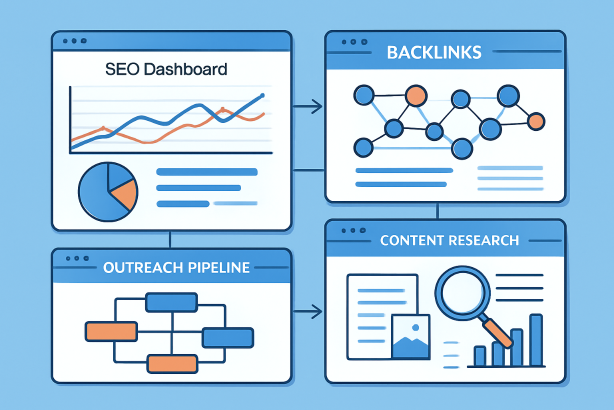
The best stack is rarely the biggest. For most teams, a practical setup includes four core capabilities:
1. Prospecting and research
You need reliable ways to discover relevant websites, analyze backlinks, and study competitors. This supports list creation and opportunity discovery.
2. Qualification and review
You need a consistent framework for judging topical relevance, page quality, editorial fit, and risk. This is where human review matters most.
3. Outreach management
You need an organized process for segmentation, personalization, contact status, and follow-up timing. This protects efficiency and brand reputation.
4. Validation and reporting
You need a way to confirm live links, monitor important placements, and report outcomes against SEO priorities.
If one part of that system is weak, more tools will not solve it. Better link building comes from alignment between process, data, and execution.
A practical checklist before you invest in more SEO tools
- Do you know exactly what part of the link building workflow needs improvement?
- Are you currently duplicating features across multiple subscriptions?
- Do you have a written qualification framework for prospects?
- Is manual review built into your process?
- Can your outreach list be segmented clearly by topic and opportunity type?
- Do you validate links technically after placement?
- Can you report outcomes by target page and business priority?
If the answer to several of these is no, fix the process before expanding the stack. Better systems usually produce better links faster than bigger software budgets do.
Use Rabbit SEO to turn SEO tools into a clearer workflow
If you want a more focused way to manage your SEO priorities, Rabbit SEO can help you organize the work behind stronger link decisions. Instead of bouncing between disconnected reports and scattered spreadsheets, you can build a clearer view of the opportunities that matter, track progress more consistently, and support a link building strategy tied to real search goals.
Explore Rabbit SEO and see how a more streamlined SEO workflow can support smarter prospecting, cleaner prioritization, and more useful reporting.
Conclusion: SEO tools are only as good as the link building decisions behind them
SEO tools can make link building more efficient, but efficiency without judgment is expensive. The biggest mistakes usually come from trusting metrics too quickly, scaling outreach too broadly, ignoring relevance, and skipping validation after the link is won. When tools support a clear process, they become an advantage. When they replace strategy, they create noise.
If you want better results from SEO tools, focus on the fundamentals: define the workflow, qualify prospects carefully, understand backlink context, organize outreach data, and measure outcomes that matter. In link building, the smartest stack is the one that helps your team choose better opportunities, not just more of them.