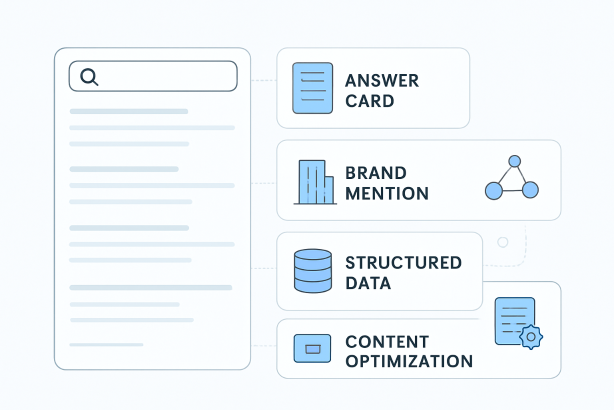

Search visibility is becoming more fragmented, more competitive, and less forgiving of weak fundamentals. Brands are no longer competing only for ten blue links. They are competing to be understood, cited, and surfaced across richer search experiences that reward clarity, structure, authority, and trust. That shift is exactly why AI visibility SEO matters right now.
The problem is that many teams are responding in the wrong way. Some treat it like a shortcut. Others chase surface-level tactics, publish generic copy at scale, or focus on keyword placement while ignoring the deeper signals that help search systems interpret a page correctly. In practice, the biggest gains usually come from avoiding obvious strategic mistakes before they become expensive visibility problems.
In this SEO News analysis, we break down the most common AI visibility SEO mistakes to avoid, why they hurt performance, and what a stronger approach looks like.
Why AI visibility SEO mistakes are getting more expensive
Modern search is increasingly shaped by interpretation, not just indexing. That means your site needs to do more than exist and rank. It needs to communicate topic coverage, entity relationships, page purpose, trust signals, and content quality in a way that is easy to parse. When those signals are weak, inconsistent, or buried under technical friction, visibility suffers.
For site owners, the implication is simple: sloppy SEO now creates a bigger downstream cost. Pages that are vague, thin, duplicated, poorly structured, or technically unreliable are not just harder to rank. They are harder to understand, harder to surface, and easier to ignore.
| Mistake | Why it hurts | What to do instead |
|---|---|---|
| Treating it as a side project | Creates disconnected strategy | Integrate with core SEO and content ops |
| Publishing generic content | Weak differentiation and low trust | Build original, decisive pages |
| Ignoring entity clarity | Confuses brand and topic relevance | Strengthen site-wide consistency |
| Missing intent alignment | Wrong page for the query | Map content to real search journeys |
| Poor formatting and schema | Reduces machine readability | Use clear structure and structured data |
| Technical debt | Blocks discovery and rendering | Fix crawl, speed, and indexation issues |
| Thin topic clusters | Signals shallow expertise | Build real topical authority |
| Weak trust signals | Limits credibility | Show expertise, ownership, and proof |
| Slow content updates | Leaves outdated pages live | Refresh priority assets regularly |
| Bad measurement | Hides what is actually working | Track visibility, coverage, and conversions |
Where teams go wrong with AI visibility SEO
1. Treating AI visibility SEO as a separate channel from core SEO
One of the most damaging mistakes is carving this work away from your existing SEO program as if it needs an entirely different playbook. It does not. The same foundations still matter: crawlability, intent alignment, strong information architecture, useful content, internal linking, trust signals, and technical health.
When teams isolate AI visibility SEO into a disconnected experiment, they usually duplicate effort and miss the real issue: their core SEO foundation is incomplete. A better approach is to treat it as an extension of modern search visibility. If a page is hard to crawl, vague in purpose, weak in structure, or unconvincing to users, no surface-level tactic will fix it.
2. Publishing generic content with no clear point of view
Generic content is one of the fastest ways to disappear into the noise. Many sites produce pages that are technically relevant to a keyword but add nothing distinctive. They rephrase what already exists, avoid specificity, and hedge every recommendation. That may fill a content calendar, but it rarely builds durable visibility.
Search systems favor pages that are clear, useful, and meaningfully differentiated. That does not mean being sensational. It means having a real angle, tighter definitions, concrete recommendations, and a structure that makes the answer obvious. If your article could be swapped with five others and no one would notice, it is probably too generic to perform well.
3. Ignoring entity SEO and brand clarity across the site
Many brands focus on keywords while overlooking the consistency of who they are, what they do, and how their expertise is expressed. This is an entity problem. If your site describes your company differently across pages, uses uneven naming conventions, or fails to connect products, services, authors, and topics clearly, you create ambiguity.
Strong entity SEO means reinforcing the same signals everywhere they matter: homepage messaging, about pages, service pages, author bios, schema markup, navigation labels, and internal links. You want search systems to see a coherent brand with clear topical associations, not a scattered collection of disconnected pages.
4. Chasing keywords while neglecting search intent mapping
Keyword research is still essential, but it is only the first layer. Too many teams target terms with decent volume without asking what the searcher actually needs at that moment. A page aimed at early research should not read like a product page. A transactional term should not lead to a vague thought leadership article.
Search intent mapping is what turns keyword targeting into useful strategy. It forces you to define whether a page should educate, compare, validate, convert, or support. When that match is wrong, rankings may stall, engagement may be weak, and the page may fail to earn broader visibility because it solves the wrong problem.
5. Overlooking structure, formatting, and structured data SEO
Even strong ideas can underperform when presentation gets in the way of interpretation. Dense paragraphs, weak heading hierarchy, buried answers, inconsistent terminology, and missing context make pages harder to process. The same is true when sites ignore structured data SEO on pages where it can clarify content type, organization details, authorship, products, FAQs, or reviews.
Good formatting is not cosmetic. It is functional. Clear headings, concise definitions, comparison tables, scannable lists, and tightly written sections help both users and search systems understand the page faster. Add structured data where it is genuinely appropriate, and you reduce ambiguity instead of forcing search engines to guess.
6. Letting technical debt block discovery and interpretation
Technical problems are still among the most common hidden causes of weak visibility. Slow pages, bloated templates, broken internal links, duplicate URLs, poor canonicals, rendering issues, thin archive pages, and messy indexation rules all reduce the efficiency of discovery and interpretation.
This is where a disciplined technical SEO audit matters. You do not need to chase every minor warning. You do need to identify the issues that interfere with crawling, indexing, page quality, and internal PageRank flow. If your most important content is buried behind poor architecture or diluted by duplicate variations, visibility will be harder to earn no matter how strong the copy is.
7. Building thin topic clusters instead of real topical authority
There is a difference between publishing around a theme and actually owning it. Many sites create topic clusters that look complete on a spreadsheet but remain shallow in practice. They publish multiple brief articles that overlap, repeat definitions, and fail to answer the harder follow-up questions a serious searcher would have.
Topical authority comes from depth, not just coverage. The strongest sites build a clear topic hierarchy, establish pillar pages, answer adjacent questions, connect supporting content intelligently, and keep everything updated. They do not just target a term. They demonstrate that they understand the category better than a casual publisher does.
8. Forgetting about trust signals, expertise, and editorial ownership
Content quality is not only about wording. It is also about credibility. Pages that lack visible authorship, publication context, review processes, contact details, or proof of expertise often feel thin even when the copy is decent. In competitive categories, that trust gap matters.
Make it easy to understand who created the content, why your brand is qualified to speak on the topic, and how users can verify your legitimacy. Strong about pages, detailed author profiles, transparent editorial standards, clear contact information, and sensible citations all help. Trust should not be implied. It should be visible.
9. Updating important pages too slowly
Search visibility is not static. Product positioning changes, SERP layouts change, competitors improve their pages, and user expectations shift. Yet many sites still publish key pages once and leave them untouched for months or years. That is a costly mistake, especially for pages targeting high-value commercial or informational terms.
A stronger process is to identify your priority assets and review them on a schedule. Refresh outdated advice, tighten internal links, improve formatting, add missing subsections, refine titles and metadata, and make sure examples still match the market. In many cases, better maintenance beats constant expansion.
10. Measuring the wrong outcomes
Some teams evaluate performance too narrowly. They track only rank positions for a few terms, or they focus only on traffic spikes without asking whether the right pages are becoming more discoverable and more commercially useful. That creates false confidence.
Better measurement looks at a wider set of signals: keyword footprint, non-brand visibility, page-level engagement, assisted conversions, internal link performance, click-through patterns, and whether strategic pages are gaining broader exposure across the topics that matter. Semantic search optimization and answer-focused visibility require a more complete view than a basic rank tracker can offer on its own.
A practical checklist to avoid these mistakes
- Unify strategy: Keep AI visibility SEO inside your core SEO roadmap.
- Sharpen page purpose: Every important page should satisfy a defined search intent.
- Clarify entities: Make brand, authors, services, and topics consistent across the site.
- Improve readability: Use strong headings, short sections, lists, and tables where helpful.
- Add useful schema: Support interpretation with relevant structured data.
- Audit technical health: Fix crawl, indexation, and internal linking issues first.
- Build depth: Create topic clusters that answer real follow-up questions.
- Show credibility: Strengthen authorship, about pages, and editorial trust cues.
- Refresh priority content: Update high-value pages before they become stale.
- Measure business impact: Track visibility alongside conversion relevance.
Need a faster way to improve AI visibility SEO?
If your team needs a practical way to spot technical issues, weak pages, content gaps, and on-page opportunities, Rabbit SEO can help you prioritize the work that actually moves search visibility forward. Instead of guessing which fixes matter most, you can focus on the pages and signals with the clearest commercial upside.
Final thoughts on AI visibility SEO
The biggest wins in AI visibility SEO rarely come from gimmicks. They come from doing the fundamentals better than your competitors: clearer content, stronger intent alignment, better structure, stronger trust signals, healthier technical foundations, and deeper topical coverage. As search behavior continues to evolve, the sites that avoid these mistakes will be in a much stronger position to earn visibility, clicks, and conversions.