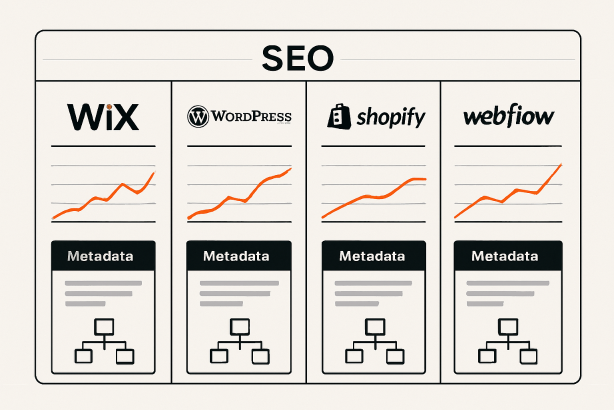

Wix & SEO is no longer a beginner-only conversation. For businesses choosing a platform today, the real question is not whether Wix can rank at all. It can. The more useful question is whether Wix is the right commercial choice compared with WordPress, Shopify, or Webflow when your goals include organic traffic, lead generation, ecommerce growth, and long-term control.
That distinction matters. A platform can be perfectly capable of publishing pages, editing titles, and generating a sitemap, yet still create limitations when your SEO program becomes more advanced. The best platform for a local service business may not be the best one for a content-heavy publisher, a scaling online store, or a brand with deep technical requirements.
In this comparison, we look at Wix & SEO through a commercial lens: what Wix does well, where it creates friction, and when another platform is the better investment.
Wix & SEO: Why the Comparison Still Matters
Wix has improved its SEO reputation over time because the platform covers many of the essentials businesses need to compete:
- Editable title tags and meta descriptions
- Custom URL slugs
- Automatic XML sitemaps
- Redirect management
- Mobile-friendly templates
- Canonical support
- Image alt text fields
- Basic structured data options
For many small and mid-sized websites, that baseline is enough to build a respectable search presence. The issue is not that Wix lacks SEO features entirely. The issue is that platform decisions affect speed, workflow, scalability, template control, content architecture, and how easily your team can execute advanced SEO over time.
That is why Wix & SEO remains a useful comparison topic in the broader SEO news cycle. As search competition becomes more demanding, platform convenience and platform ceiling are not the same thing.
What Wix Gets Right for SEO
1. Fast setup for non-technical teams
Wix makes it easy to launch pages without depending heavily on developers. That speed matters commercially. If a marketing team can publish service pages, landing pages, and blog content quickly, the business can move faster on opportunities.
2. Solid built-in SEO foundations
From a practical standpoint, most businesses need strong control over on-page basics first. Wix SEO settings cover the core elements most teams touch every week: page titles, descriptions, headings, image alt text, URL editing, and redirects. For many local businesses, consultants, agencies, and brochure-style sites, this covers a large share of day-to-day SEO work.
3. Centralized management
Wix is attractive for owners who want design, hosting, security, and content management in one place. That reduces operational complexity. For teams with limited technical support, simplicity is not a minor benefit; it is often the reason work gets done consistently.
4. Good fit for local and small business SEO
If your strategy centers on local service pages, location pages, testimonials, FAQs, and regular blog publishing, Wix can be enough. In those cases, the biggest ranking gains usually come from better content, internal linking, stronger offers, and cleaner keyword targeting rather than from highly customized technical builds.
Where Wix Still Creates SEO Trade-Offs
1. Less flexibility than open platforms
The core commercial weakness of Wix is not basic optimization. It is limited freedom compared with more customizable ecosystems. If your SEO roadmap includes large-scale content models, complex template logic, deep schema customization, or specialized performance work, Wix can feel restrictive faster than WordPress.
2. Template and structural constraints
Businesses often underestimate how much site architecture affects SEO execution. The ability to restructure content templates, refine category systems, improve internal linking patterns, or deploy technical changes across large page sets can make a major difference. On Wix, those tasks are possible to a point, but usually with less freedom than on platforms designed for deeper customization.
3. Ecommerce depth is not its strongest commercial case
Wix supports ecommerce, but for SEO-heavy stores with large catalogs, faceted navigation concerns, collection page strategy, and more advanced merchandising requirements, Shopify often provides a clearer path. Wix can work for smaller stores, but the margin for growth becomes part of the decision.
4. Advanced teams may outgrow it
When SEO involves content teams, developers, designers, CRO specialists, and technical consultants all working together, platform flexibility starts to matter more than ease of use. At that stage, Wix may still function, but it may no longer be the most efficient environment.
Wix & SEO vs WordPress
Wix vs WordPress SEO is the most important comparison for content-led businesses.
| Area | Wix | WordPress |
|---|---|---|
| Ease of setup | Very simple | Varies by hosting and build |
| SEO flexibility | Good for core needs | Excellent with the right setup |
| Scalability | Moderate | High |
| Design and template control | Managed environment | Highly customizable |
| Plugin ecosystem | Limited compared with WordPress | Extensive |
| Best fit | Small to mid-sized businesses | Content-heavy and growth-focused sites |
WordPress usually wins when SEO is central to the business model. That includes publishers, SaaS companies, lead generation brands, and service businesses with aggressive content strategies. The reason is simple: WordPress offers far more control over templates, taxonomy, technical implementations, editorial workflows, and third-party integrations.
Wix wins when convenience matters more than maximum flexibility. If you want to avoid plugin management, hosting decisions, and developer dependency, Wix can be the more practical choice. But if your business expects SEO to become a major acquisition channel, WordPress often gives you a higher ceiling.
Wix & SEO vs Shopify
Wix vs Shopify SEO is really a question of business model. If ecommerce is the center of your website, Shopify is usually the more focused platform.
| Area | Wix | Shopify |
|---|---|---|
| General website flexibility | Strong for mixed-use sites | Built around ecommerce |
| Product catalog management | Good for smaller stores | Stronger for larger stores |
| Collection and merchandising workflows | More limited | More mature |
| Content marketing environment | Simple and accessible | Usable but often secondary to store logic |
| Best fit | Service brands with light ecommerce | Stores where ecommerce growth leads the strategy |
If your website is mainly a branded presence with a modest store attached, Wix can be a reasonable all-in-one solution. If you are planning category expansion, collection page optimization, and a more advanced store architecture, Shopify is often the safer commercial bet.
This matters because technical SEO for Wix may be manageable for a small shop, but scaling product-led SEO requires stronger systems around site structure, inventory, and merchandising. Shopify is simply more purpose-built for that challenge.
Wix & SEO vs Webflow
Wix vs Webflow SEO is the cleanest comparison for design-led brands.
| Area | Wix | Webflow |
|---|---|---|
| Ease of use | More beginner-friendly | Steeper learning curve |
| Design precision | Good within platform limits | Excellent for custom layouts |
| SEO control | Strong basics | Strong basics with more design freedom |
| Developer reliance | Lower | Often higher for complex builds |
| Best fit | Simple business sites | Brand-led marketing sites |
Webflow appeals to teams that care deeply about visual control and modern front-end execution. It can be a strong SEO option when paired with a capable team, especially for marketing sites that need custom layouts and cleaner design systems. Wix remains easier for non-specialists, but Webflow often feels more premium for brands with stronger design and development resources.
So, What Is the Best Website Builder for SEO?
There is no universal winner because the best website builder for SEO depends on what your business actually needs to rank and convert.
- Choose Wix if you want simplicity, speed, and a low-friction publishing workflow for a small or mid-sized business website.
- Choose WordPress if content, organic growth, and long-term SEO flexibility are central to your strategy.
- Choose Shopify if ecommerce is the revenue engine and your SEO work will revolve around collections, products, and store architecture.
- Choose Webflow if design quality and custom marketing pages matter as much as standard SEO controls.
The practical takeaway is that on-page SEO for Wix can be absolutely sufficient for many businesses. The risk appears when teams assume that sufficient today means ideal tomorrow.
Who Should Use Wix for SEO?
Wix is a commercially smart option for:
- Local service businesses
- Freelancers and consultants
- Agencies launching lean brochure sites
- Businesses with small content teams
- Brands that value convenience over deep customization
Wix is a less compelling choice for:
- Large editorial sites
- Businesses building SEO at scale across many templates
- Complex ecommerce operations
- Teams needing highly customized technical implementations
- Organizations expecting major architecture changes over time
A Smart SEO Checklist if You Stay on Wix
If Wix is already your platform, the right move is not panic. It is better execution. Focus on the work that usually drives the biggest results:
- Map one primary keyword intent to each important page
- Improve page titles, H1s, meta descriptions, and internal links
- Build stronger service and location pages
- Publish useful blog content tied to commercial intent
- Compress images and keep layouts clean
- Check crawlability, canonicals, redirects, and sitemap coverage
- Add clear trust signals, FAQs, and conversion paths
- Review whether your current site structure supports future growth
In other words, platform choice matters, but weak SEO on a flexible platform is still weak SEO. Many Wix sites underperform because of thin content, poor keyword targeting, and weak internal linking, not because Wix itself makes rankings impossible.
Commercial Verdict: Wix & SEO
Wix & SEO is a viable combination for many businesses, especially when ease of use, quick deployment, and manageable site operations are top priorities. It is no longer accurate to dismiss Wix as incapable of ranking.
At the same time, commercial buyers should be honest about growth expectations. If your business will depend heavily on advanced content strategy, scalable technical SEO, or complex ecommerce architecture, WordPress or Shopify may be the better long-term investment. If your brand needs greater design freedom with solid SEO fundamentals, Webflow may be the stronger fit.
The right question is not, “Can Wix rank?” The right question is, “Will Wix still serve our SEO strategy well two years from now?” That is the comparison that saves time, budget, and avoidable platform migration later.
Need Help Turning Platform Potential Into Search Revenue?
Whether you stay on Wix or move to another platform, rankings come from execution. If you want a clearer SEO roadmap, stronger content targeting, and a site structure built for commercial growth, Rabbit SEO can help you identify the quickest wins and the right long-term priorities for your website.
Explore more expert SEO insights on Rabbit SEO Blog and make your next platform decision with a search strategy behind it.
Conclusion: Wix & SEO in Plain Terms
Wix & SEO works best when your business needs a practical, easy-to-manage website with solid core optimization features. It becomes less attractive as your SEO program becomes more technical, content-heavy, or ecommerce-driven. For straightforward business sites, Wix can be the right commercial choice. For larger ambitions, a more flexible platform may produce better long-term SEO economics.