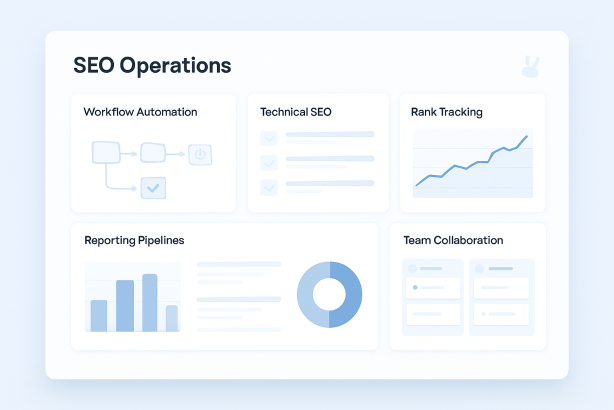

In 2026, SEO automation software is no longer a nice-to-have for fast-moving teams. It is becoming part of the operating system for modern search growth. As websites expand, content calendars tighten, and technical requirements become more complex, manual SEO management creates delays, inconsistency, and missed opportunities.
At the same time, the best teams are learning an important lesson: strong automation is not about replacing strategy. It is about removing repetitive work, standardizing quality, and making sure the right people can focus on the decisions that still require judgment.
That is why the conversation around SEO automation software in 2026 is changing. The question is no longer whether teams should automate. The real question is how to automate responsibly, efficiently, and in ways that actually improve SEO outcomes over time.
This guide covers the best practices that matter most this year, from technical SEO automation and reporting to workflow design, governance, and tool selection.
Why SEO automation software matters more in 2026
Search operations are more interconnected than they were just a few years ago. A single SEO campaign can involve technical audits, internal linking, content briefs, rank tracking, issue prioritization, reporting, stakeholder approvals, and implementation across multiple teams. When those tasks are managed manually, friction builds quickly.
SEO automation software helps solve that operational problem by creating repeatable systems. Instead of relying on memory, spreadsheets, and ad hoc follow-up, teams can automate recurring checks, route tasks to the right owners, and create clearer visibility into what is happening across the SEO program.
In practice, that leads to several advantages:
- More consistent execution of recurring SEO tasks
- Faster detection of technical issues and content gaps
- Better alignment between SEO, content, development, and leadership
- Cleaner reporting and stronger accountability
- Less time spent on administrative work
But those gains only happen when automation is implemented with a clear framework.
Best practice #1: Automate repeatable workflows, not strategic judgment
The biggest mistake teams make with SEO automation is trying to automate everything equally. Not every SEO task should be handled the same way.
The best rule for 2026 is simple: automate what is repeatable, time-consuming, and rules-based. Keep human review for what requires nuance, prioritization, and business context.
| SEO area | Good candidate for automation | Should remain human-led |
|---|---|---|
| Technical SEO | Crawl checks, issue alerts, scheduled audits | Issue prioritization based on business impact |
| Content workflow | Task routing, status updates, publishing checklists | Topic strategy, editorial positioning, brand voice |
| Reporting | Recurring dashboards, performance summaries, stakeholder distribution | Interpretation, recommendations, executive framing |
| Keyword monitoring | Rank tracking automation, SERP movement alerts | Keyword selection, intent mapping, opportunity decisions |
This distinction matters because SEO performance rarely improves from automation alone. It improves when automation supports better decisions and stronger execution.
Best practice #2: Build SEO workflow automation around triggers and ownership
Many companies adopt new tools but still struggle because their workflows remain vague. If nobody knows what triggers an action, who owns the next step, or when escalation should happen, software will not fix the process.
That makes SEO workflow automation one of the most important focus areas for 2026.
Effective workflows usually include:
- A clear trigger: for example, a crawl error spike, a page template change, or a major ranking drop
- A defined owner: who reviews the issue first and who is responsible for execution
- A response path: whether the issue becomes a ticket, an editorial revision, or a technical fix
- A priority framework: how to separate urgent revenue-impacting issues from routine maintenance
- A verification step: how the team confirms the problem is resolved
In other words, the software should support an operating model, not replace one.
Example workflow structure
A practical structure for teams in 2026 looks like this:
- Scheduled crawl identifies a new indexing issue
- Automation flags affected sections and sends an alert
- Issue is routed to the SEO lead and technical owner
- Priority is assigned based on traffic, page type, and business value
- Implementation task is created for development
- Post-fix validation runs automatically on the next crawl
- Status is added to reporting for stakeholders
That is much stronger than a manual process where issues sit unnoticed until performance drops enough to trigger concern.
Best practice #3: Use technical SEO automation to catch issues early
Technical SEO automation should be one of the first areas teams improve in 2026. Technical issues often affect large sections of a site at once, and the cost of late detection can be high.
Useful forms of automation include:
- Automated site audits on a recurring schedule
- Alerts for broken internal links, redirect chains, and server errors
- Monitoring for changes to canonicals, robots directives, and noindex tags
- Checks for duplicate titles, missing metadata, and thin pages at scale
- Validation of sitemap health and indexation signals
The key is not simply collecting more issue data. The key is filtering noise. In 2026, mature teams are moving away from massive lists of low-value warnings and toward cleaner, prioritized technical queues.
A good workflow asks:
- Does this issue affect important pages or templates?
- Is it new, growing, or recurring?
- Does it block crawling, indexing, or user experience?
- Can it be grouped into a larger root-cause fix?
Without that layer of prioritization, automation can create more work instead of less.
Best practice #4: Treat reporting as an automation priority, not an afterthought
Too many SEO teams still spend valuable time building recurring updates by hand. In 2026, that is one of the clearest opportunities for improvement.
Strong SEO reporting software should automate the routine parts of communication while leaving room for expert interpretation. That means recurring dashboards, performance snapshots, issue trend summaries, and stakeholder-specific reporting should happen on a consistent schedule without manual assembly each time.
The benefits are straightforward:
- Stakeholders get updates on time
- Metrics stay consistent from report to report
- Teams spend less time exporting and formatting data
- SEO leads can focus on explaining what changed and what to do next
For best results, separate reporting into three layers:
- Operational reporting: tasks completed, issues opened, issues resolved
- Performance reporting: rankings, organic traffic, landing page movement, conversions where available
- Executive reporting: business impact, risks, next-quarter priorities, resource needs
Automation works best when each audience receives the right level of detail rather than one oversized report for everyone.
Best practice #5: Connect rank tracking automation to action
Rank tracking automation is useful, but rankings by themselves are not a strategy. In 2026, the better approach is to connect monitoring directly to action thresholds.
For example, teams can define alerts for:
- Meaningful drops on priority keywords
- Page-level movement in key commercial clusters
- Competitor gains on terms linked to revenue pages
- Volatility across a category after a site update or content release
Once alerts are in place, the workflow should specify what happens next. Does the page get re-reviewed for intent match? Does internal linking need reinforcement? Is there a template issue affecting a wider group of URLs?
This is where automation becomes operationally valuable. It turns passive monitoring into a response system.
Best practice #6: Standardize quality controls before scaling automation
Automation amplifies whatever process already exists. If the current workflow is inconsistent, unclear, or loosely documented, adding software can magnify the mess.
Before scaling SEO task automation, define quality controls for the basics:
- What counts as a completed technical fix
- What must be reviewed before content is published or updated
- How internal links are checked and approved
- Which metrics are used in recurring reports
- How issues are labeled by severity and business impact
Documented rules make automation more reliable. They also make onboarding easier, especially for larger teams or agencies managing multiple clients.
This is one reason enterprise SEO tools are increasingly evaluated on governance features, not just raw functionality. Teams want automation that supports approvals, permissions, accountability, and process consistency across departments.
Best practice #7: Choose SEO automation software that fits your operating model
Not every platform is built for the same type of team. A lean in-house SEO function, a content-heavy publisher, and a large multi-market brand will have different requirements.
When evaluating SEO automation software in 2026, focus on fit before feature lists. A tool is only valuable if it aligns with how your team actually works.
Questions to ask during evaluation
- Does it support recurring workflows our team uses every week?
- Can it handle technical SEO automation without overwhelming us with noise?
- Does it make reporting easier for both practitioners and stakeholders?
- Can tasks be assigned, tracked, and verified cleanly?
- Does it integrate well with our existing content, development, or analytics stack?
- Will it still work as our site, team, or reporting needs grow?
It is also wise to assess usability. Even powerful software fails when adoption is low. In many organizations, a simpler system that teams use consistently outperforms a larger stack that nobody fully maintains.
Best practice #8: Review automation rules quarterly
SEO is not static, and neither should automation be. New site sections launch, priorities shift, teams restructure, and search visibility patterns change. Rules that made sense six months ago may no longer match the business.
That is why automation should be reviewed on a quarterly basis. Use those reviews to assess:
- Which alerts create useful action and which create noise
- Whether issue severity labels still reflect business priorities
- Which reports stakeholders actually read and use
- Whether technical checks cover the most important templates and page types
- Whether workflow bottlenecks are happening at the handoff stage
This review discipline is what separates mature automation from tool sprawl.
What the best SEO automation software teams will do differently in 2026
The strongest teams in 2026 will not win because they automated the most tasks. They will win because they automated the right tasks, connected automation to accountability, and kept strategy at the center of the work.
They will use software to:
- Detect issues faster
- Reduce repetitive manual effort
- Improve visibility across SEO operations
- Keep reporting consistent
- Help teams execute with fewer delays
And just as importantly, they will avoid common traps:
- Automating unclear processes
- Measuring too much and acting on too little
- Using tools without ownership rules
- Overloading teams with unprioritized alerts
- Confusing activity volume with SEO progress
A practical next step for teams evaluating SEO automation software
If your current SEO process still depends on scattered documents, manual audits, repetitive status updates, or inconsistent reporting, this is a good time to simplify. Start by mapping your highest-friction recurring tasks, then identify where automation can improve speed, consistency, and accountability without reducing strategic oversight.
If you are exploring a cleaner way to manage recurring SEO work, Rabbit SEO is worth a closer look. It can help teams bring important workflows into one place, reduce manual overhead, and create a more structured approach to ongoing optimization and reporting.
Conclusion: SEO automation software should make SEO operations better, not busier
The best SEO automation software in 2026 will not be defined by how many features it lists. It will be defined by how well it helps teams work: faster on repetitive tasks, clearer on priorities, and more consistent in execution.
That is the real standard for this year. Use automation to strengthen your process, not to hide a weak one. Build around ownership, prioritization, and reporting clarity. Keep strategy human-led. And review your workflows often enough to make sure your automation still reflects the business you are trying to grow.
When implemented well, SEO automation software becomes more than a productivity layer. It becomes a practical advantage in how modern SEO gets planned, delivered, and scaled.