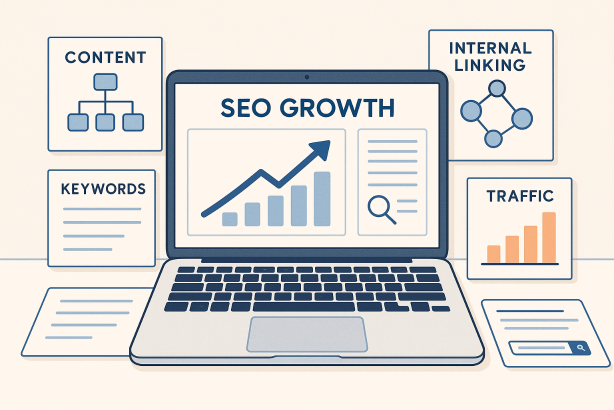

Anyone searching for how to get more website visitors is usually asking a bigger question: how do you build traffic that keeps growing without relying on random spikes, one-off social posts, or expensive paid campaigns?
Right now, the biggest trend in SEO is not simply publishing more content. It is building better search coverage. Sites that win are the ones that cover a topic deeply, match search intent precisely, refresh old pages consistently, and turn every ranking page into a connected traffic hub. In other words, growth comes from structure, not volume.
If you want a practical answer to how to get more website visitors, this guide breaks down what is working now: smarter keyword targeting, stronger content clusters, better internal linking, sharper click-through rates, and the technical fixes that remove hidden traffic ceilings.
The hot trend: traffic growth now comes from complete search coverage
For years, many sites treated SEO like a simple publishing formula: find one keyword, write one article, and hope it ranks. That approach is weaker today because search results reward relevance across an entire topic, not just on a single page.
The stronger model is to build complete search coverage around the questions, comparisons, problems, and next steps your audience cares about. This means:
- Creating pillar pages for core topics
- Publishing supporting articles for closely related questions
- Linking those pages together clearly
- Updating older content so it stays competitive
- Improving titles and descriptions so more people click
This shift matters because traffic is rarely won by one page alone. It is won when your site becomes the best next click for multiple related searches.
How to get more website visitors by matching the full search journey
If your content strategy only targets high-volume keywords, you will miss a large share of qualified traffic. Modern keyword research needs to reflect the full journey from curiosity to decision.
1. Identify the main intent behind each query
Every keyword has a reason behind it. The page that ranks needs to match that reason.
- Informational intent: people want to learn something
- Comparative intent: people are evaluating options
- Commercial intent: people are close to taking action
- Navigational intent: people are looking for a specific brand or page
When a page mismatches intent, it usually struggles even if the writing is strong. A broad educational article will not satisfy someone searching for a product comparison, and a sales page will not satisfy someone looking for basic definitions.
2. Build topic maps instead of disconnected keyword lists
A strong SEO content strategy groups related keywords into clusters. For example, if your core topic is website traffic growth, supporting content might include:
- How to increase organic traffic
- How to do keyword research for new pages
- Best internal linking tactics for SEO
- How to refresh old blog posts
- How to improve click through rate from search results
These topics reinforce each other. Together, they send a stronger topical signal than isolated blog posts published without a clear structure.
3. Prioritize relevance over raw search volume
High-volume keywords can be attractive, but qualified traffic often comes from more specific searches. A smaller keyword with clear intent can produce better results than a broad term that attracts the wrong visitors.
When deciding what to publish, ask:
- Does this query fit our product, service, or expertise?
- Can we create a page that is more useful than what already ranks?
- Will this page naturally connect to other pages on our site?
- Does this topic support long-term authority?
Build content clusters that earn rankings and compound traffic
One of the most reliable ways to increase organic traffic is to organize your site around content clusters. This creates a clear relationship between your most important pages and the supporting pages that strengthen them.
What a content cluster looks like
A cluster usually includes:
- A pillar page targeting the broad core topic
- Several supporting articles targeting subtopics and long-tail searches
- Clear internal linking between all relevant pages
For example, a pillar page on getting more website visitors could link to supporting pages about technical SEO, content refreshes, title tag optimization, search intent, and referral traffic.
Why clusters work now
Clusters improve SEO in several ways:
- They help search engines understand your site structure
- They spread authority across related pages
- They keep readers moving deeper into your content
- They reduce reliance on a single page ranking for a single term
This is especially important in competitive niches where broad terms are hard to win. Supporting pages can rank faster, send qualified traffic, and strengthen the main page over time.
Refresh old content before you publish more new content
Many sites ask how to get more website visitors while ignoring pages that already have some visibility. That is a missed opportunity. In many cases, the fastest traffic gains come from improving existing content rather than starting from zero.
What to look for in older posts
- Pages ranking on page two or the lower half of page one
- Posts with declining impressions or clicks
- Articles with outdated examples, screenshots, or terminology
- Pages that rank for unexpected keywords but do not fully address them
- Posts that attract traffic but fail to guide users to related content
How to refresh strategically
- Recheck search intent and compare your page to current top results
- Tighten the introduction so it answers the main query faster
- Add missing subtopics, examples, FAQs, or comparisons
- Improve formatting with better headings, lists, and tables
- Update internal links to and from the page
- Rewrite the title tag and meta description to improve click through rate
A refresh should make a page more useful, more complete, and easier to navigate. It is not about changing a few words and updating the date.
Improve click-through rate to win more visitors from the rankings you already have
Rankings matter, but rankings alone do not guarantee traffic. If your page appears in search results and users do not click, you are leaving visitors on the table.
Write titles that earn attention without becoming vague
Strong titles usually do one or more of the following:
- Promise a clear outcome
- Signal timeliness or freshness
- Use specific wording that matches the query
- Differentiate the page from generic competitors
Compare a generic title like Website Traffic Tips to something more specific like How to Get More Website Visitors: What’s Working Now in SEO. The second title is clearer, more relevant, and better aligned with current intent.
Make meta descriptions pull their weight
Meta descriptions do not always control what search results display, but they still help shape clicks when used well. A good description should explain what the page offers, who it is for, and why it is worth visiting now.
Use better page formatting to support engagement
Clicking is only the first step. Once users land on the page, they need to find value quickly. Strong formatting improves both usability and retention:
- Short paragraphs
- Descriptive headings
- Bullets and numbered steps
- Tables for comparisons
- Clear next-action links
The easier your page is to scan, the more likely users are to stay, explore, and return.
Turn every successful page into a traffic hub
If a page is already attracting visitors, treat it like an asset that should distribute attention across your site. Too many pages rank, get clicks, and then become dead ends.
Use internal linking to move readers deeper
Strong internal linking helps both users and search engines. Every high-performing page should point readers toward the next logical step, such as:
- A deeper guide on a subtopic
- A comparison page for evaluating options
- A product or service page
- A related case example or tutorial
The key is relevance. Internal links should feel like a natural continuation, not an unrelated promotion.
Add conversion paths without overwhelming the reader
If your goal is not just traffic but business growth, high-traffic pages need simple conversion paths. That could include:
- A product mention in context
- A free tool or checklist
- An email signup
- A demo or consultation CTA
The best pages do not force a hard sell. They create an obvious next step for visitors who are ready.
Expand beyond search without losing your SEO focus
If you want more website visitors, search should be the foundation, but it should not be the only channel. The strongest growth strategies amplify SEO content through distribution.
Channels that can strengthen SEO performance
- Email: send new and refreshed content to subscribers
- Communities: share useful answers in relevant forums and groups
- Partnerships: collaborate with brands, publishers, or newsletters in your niche
- Social platforms: repurpose key insights from your articles into short-form content
Distribution does more than generate direct visits. It can lead to branded searches, repeat visits, and natural links, all of which support long-term visibility.
Fix the technical SEO issues that quietly cap traffic
You can publish excellent content and still underperform if your site has technical barriers. Technical SEO rarely creates traffic by itself, but it often determines whether your content can reach its potential.
Key checks to make regularly
- Indexation: important pages should be crawlable and indexable
- Site speed: slow pages can reduce engagement and frustrate mobile users
- Mobile usability: content should be easy to read and navigate on smaller screens
- Duplicate content control: use canonicals and clean site architecture where needed
- Broken links: fix internal 404s and outdated redirects
- Thin pages: consolidate or improve weak content that adds little value
Technical work is often ignored because it feels less visible than publishing, but hidden friction can suppress otherwise strong pages.
Measure what is actually bringing more website visitors
Not all traffic growth is equal. You need to know which efforts are producing useful visits, not just higher pageview totals.
| Metric | Why it matters | What to do with it |
|---|---|---|
| Organic clicks | Shows real search traffic growth | Identify pages and topics gaining traction |
| Impressions | Reveals expanding visibility | Spot pages with ranking potential but weak CTR |
| Click-through rate | Measures how compelling your result is | Rewrite titles and descriptions on underperforming pages |
| Average position | Helps track ranking movement | Prioritize pages close to page-one gains |
| Engaged sessions | Shows traffic quality, not just volume | Improve page structure and next-click paths |
| Conversions | Ties traffic to business value | Optimize CTAs and landing page relevance |
A simple rule helps here: focus on pages that already show signs of life. If a URL is getting impressions but low clicks, improve the snippet. If it is getting clicks but poor engagement, improve the content. If it is engaging visitors but not converting, fix the next step.
A practical 90-day plan for how to get more website visitors
If you want momentum without overcomplicating execution, follow a staged plan.
Days 1 to 30: audit and prioritize
- List your top-performing pages by impressions and clicks
- Find pages ranking just outside top positions
- Map your main topics and identify missing cluster content
- Review technical issues affecting crawlability and page quality
Days 31 to 60: refresh and strengthen
- Update your most promising existing pages
- Improve title tags and meta descriptions
- Add internal links between related pages
- Consolidate weak or overlapping articles
Days 61 to 90: publish and distribute
- Launch supporting cluster content around your core topics
- Promote refreshed and new content through email and partnerships
- Track CTR, rankings, and engaged traffic
- Double down on the topics showing the strongest traction
This approach is more effective than publishing at random because it compounds. Each action supports the others.
Need a faster way to uncover traffic opportunities?
If you want to grow search visibility without guessing, Rabbit SEO can help you find keyword opportunities, spot content gaps, improve on-page targeting, and strengthen the structure behind your traffic strategy. Instead of chasing isolated wins, you can build a clearer plan for sustainable growth across the pages that matter most.
If your goal is to get more qualified visitors, now is a good time to turn that strategy into a repeatable system. Explore Rabbit SEO and start building a stronger traffic engine page by page.
How to get more website visitors without chasing shortcuts
The best answer to how to get more website visitors is no longer “publish more and hope.” What works now is deeper topic coverage, sharper search intent alignment, stronger content clusters, better internal linking, higher click-through rates, and ongoing content refreshes supported by clean technical SEO.
If you apply those principles consistently, traffic growth becomes less random and more predictable. You stop relying on one viral post or one lucky ranking and start building a site that earns attention across an entire topic space. That is how to get more website visitors in a way that lasts.