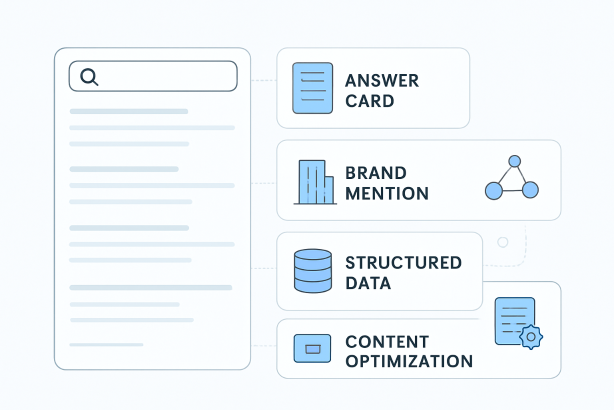

Search is changing faster than most editorial calendars can keep up with. Traditional rankings still matter, but they now sit alongside answer boxes, summary layers, recommendation panels, product snapshots, and brand mentions that may appear before a user ever clicks a blue link. That shift is why AI visibility SEO has become one of the most important topics in SEO News.
If your team is still measuring success only by position tracking and organic sessions, you may miss the wider visibility picture. Brands now need to think about how their pages are understood, cited, summarized, and surfaced across multiple search experiences. In practice, that means stronger content structure, clearer entity signals, tighter topical coverage, and sharper alignment with search intent.
This guide answers the biggest questions marketers, founders, and in-house SEO teams are asking about AI visibility SEO right now, with a practical focus on what to do next.
What is AI visibility SEO?
AI visibility SEO is the practice of improving how your brand, site, products, and expertise appear across modern search experiences that generate direct answers, summaries, recommendations, or cited references instead of relying only on classic ten-blue-links rankings.
It overlaps with traditional SEO, but it is not simply a new label for the same work. The goal is broader than ranking one page for one keyword. The goal is to build content and site signals that help search systems understand:
- Who your brand is
- What topics you truly own
- Which pages best answer specific questions
- How trustworthy and consistent your information is
- When your content deserves to be surfaced, summarized, or referenced
In other words, AI visibility SEO expands SEO from position to presence. That is why many teams now discuss it alongside answer engine optimization, entity SEO, and brand visibility in search.
Why is AI visibility SEO suddenly a priority?
Because user behavior is adapting to new search interfaces. People increasingly expect immediate answers, fast comparisons, and concise summaries. They may refine fewer queries, click fewer results, and make decisions earlier in the journey.
For publishers and commercial sites, that creates two realities at once:
- Opportunity: strong content can appear in more formats than before
- Risk: weakly structured or poorly differentiated content can lose attention even if it still ranks
This is why zero-click search is part of the discussion. Visibility now includes more than visits. If your brand is repeatedly surfaced as a trusted source, included in comparisons, or recognized for a category topic, that exposure can influence demand, branded searches, and conversions later in the journey.
In SEO News terms, the shift is not about abandoning search fundamentals. It is about adapting those fundamentals to interfaces that reward clarity, coverage, authority, and machine-readable structure.
How is AI visibility SEO different from traditional SEO?
Traditional SEO often centers on ranking improvement for target keywords, crawling and indexing health, link equity, and on-page optimization. Those remain essential. AI visibility SEO adds another layer: how well your content can be interpreted, selected, and represented in answer-led environments.
| Traditional SEO focus | AI visibility SEO focus |
|---|---|
| Ranking pages | Earning visibility across answers, summaries, and recommendations |
| Keyword targeting | Topic modeling, entities, and contextual relevance |
| Clicks from SERPs | Presence before the click and influence across the journey |
| Metadata and links | Metadata, links, structured content, and citation-ready information |
| Single-page optimization | Sitewide topic architecture and brand consistency |
The strongest strategies combine both. If your technical foundation is weak, visibility suffers. If your content lacks substance or structure, visibility also suffers. This is not a replacement discipline. It is an expanded operating model for search.
What kind of content performs best for AI visibility SEO?
The best content for AI visibility SEO is content that is easy to understand, specific enough to be useful, and broad enough to show real topical depth. In practice, that usually means:
- Clear question-and-answer sections that match real user queries
- Concise definitions near the top of the page
- Structured comparisons for commercial evaluation queries
- Step-by-step guidance for process-driven searches
- Original positioning that shows why your brand deserves inclusion
- Strong internal linking that maps related subtopics
Thin articles built around one repeated phrase tend to underperform in the long run. So do pages that are hard to scan, lack context, or bury the direct answer below generic introductions. Search systems prefer content that can be parsed quickly and trusted easily.
This is where search intent optimization becomes critical. If the query is informational, answer it plainly. If the query is comparative, include criteria. If the query has commercial intent, explain trade-offs, use cases, pricing factors, and next steps without sounding overly promotional.
Does schema markup matter for AI visibility SEO?
Yes. Schema markup matters because it helps clarify what a page is about, what type of content it contains, and how different site elements relate to each other. Schema will not rescue weak content, but it can strengthen the interpretability of strong content.
Useful structured data often includes page types and business context such as:
- Organization
- Article
- FAQPage where appropriate
- Product or Service pages when relevant
- Breadcrumbs
- Author and publisher signals where supported
The key is accuracy. Overloaded, misleading, or outdated markup creates confusion rather than clarity. Treat schema as part of a wider entity and information architecture strategy, not as a one-click shortcut.
For teams working on entity SEO, schema also supports stronger consistency between your brand, your authors, your services, and your topic clusters. That consistency improves how your site is interpreted across search surfaces.
How important is brand authority in AI visibility SEO?
It is extremely important. One of the biggest shifts in search is that brands are no longer competing only page against page. They are competing trust profile against trust profile.
Strong brand visibility in search comes from repeated signals that your site is a dependable source in a defined subject area. Those signals include:
- Consistent topical coverage
- Clear author and editorial positioning
- Accurate About, Contact, and company information
- Referenced brand mentions across the web
- Logical internal linking between core pages
- Commercial pages that support informational content rather than conflict with it
This does not mean only large brands can win. Smaller sites can compete if they are sharply focused. In many niches, narrow expertise beats broad but shallow publishing. The lesson is simple: do not try to look authoritative everywhere. Become unmistakably useful somewhere specific, then expand from that base.
What role does topical authority play?
Topical authority is one of the strongest foundations of AI visibility SEO. If your site publishes disconnected posts without a coherent theme, search systems may struggle to understand what you truly specialize in. If your content library shows depth, hierarchy, and continuity, understanding becomes much easier.
A practical topical authority framework looks like this:
- Pillar pages define the main topic clearly
- Cluster pages answer sub-questions in detail
- Commercial pages connect solutions to user needs
- Editorial updates keep the topic current
- Internal links establish relationships between concepts
For example, a site targeting AI visibility SEO should not stop at one article. It should also cover related subjects such as schema strategy, entity optimization, content refresh workflows, citation-ready writing, search summary formatting, and measurement frameworks. That breadth tells search systems your site has real depth, not just opportunistic coverage.
How should pages be written and formatted for AI visibility SEO?
Formatting matters more than many teams realize. Well-structured content is easier to read, easier to index, and easier to extract into summaries or answer elements.
Best practices include:
- Use one clear topic per page
- Place the direct answer high on the page
- Use descriptive headings that mirror real questions
- Keep paragraphs tight and focused
- Use lists and tables when they improve clarity
- Define important terms simply before going deeper
- Avoid filler introductions and vague generalities
Think of each section as a stand-alone answer that still contributes to the whole article. That is one reason Q&A content works well: it mirrors the way users search and the way modern interfaces retrieve information.
At the same time, do not flatten everything into robotic short answers. Premium content still needs editorial judgment, nuance, and a clear point of view. The goal is useful structure, not lifeless copy.
What are the biggest mistakes brands make with AI visibility SEO?
The most common mistakes are strategic, not technical.
1. Treating it like a trend instead of a search shift
Many brands publish one article on the topic and move on. That usually produces little result. AI visibility SEO works best as a sitewide content, structure, and authority initiative.
2. Chasing keywords without building topic depth
If every page targets a different phrase with no connective architecture, your site may rank occasionally but struggle to become a recognized source.
3. Publishing generic summaries with no differentiation
Content that says what everyone else says is less likely to stand out. Add specificity, examples, process clarity, and a clear commercial perspective where relevant.
4. Ignoring entity consistency
Your brand name, service descriptions, author profiles, and company positioning should align across the site. Mixed signals weaken entity SEO.
5. Measuring only clicks
Traffic still matters, but it is not the whole story. Visibility also shows up in branded demand, assisted conversions, lead quality, and how often your content appears to shape a decision before the visit.
How can you measure AI visibility SEO without overcomplicating it?
Start with a simple measurement stack. You do not need a bloated dashboard to understand progress.
Track:
- Core rankings for priority commercial and informational terms
- Organic clicks and impressions in Search Console
- Growth in branded queries
- Pages earning rich results or enhanced SERP features
- Visibility of topic clusters, not just isolated URLs
- Lead or revenue contribution from organic landing pages
Then add qualitative review. Search your target queries regularly. Look at what kinds of pages are being surfaced. Are list pages winning? Are FAQs appearing? Are product comparison formats dominating? Are concise definitions being rewarded? Those observations often reveal more about the direction of search than raw ranking movement alone.
The goal is to connect visibility signals to commercial outcomes, not to collect every possible metric.
What is a practical AI visibility SEO action plan for the next 90 days?
If you want a realistic starting point, focus on execution instead of theory.
- Audit your topic coverage. Identify your core themes, missing subtopics, and weak overlaps.
- Refresh your most important pages. Add direct answers, better headings, clearer definitions, and stronger internal links.
- Improve entity signals. Align About pages, author bios, service pages, organization details, and schema markup.
- Build Q&A assets. Publish practical pages that address the exact questions buyers and researchers ask.
- Strengthen commercial-intent content. Make solution pages more useful, not just more sales-focused.
- Review search presentation. Study how your topics are currently surfaced and adapt your formatting accordingly.
- Create a cluster roadmap. Plan supporting content around your highest-value topics.
This kind of focused work usually creates more progress than launching dozens of shallow posts.
Should every business care about AI visibility SEO?
Yes, but not every business should approach it the same way. A SaaS company, publisher, local service business, and ecommerce brand will each need a different execution model. The shared principle is that search visibility now depends on how clearly your business and content can be understood across more than one results format.
For some businesses, the priority is informational authority. For others, it is product discoverability, category relevance, or local brand recognition. The right strategy begins with business goals, then maps those goals to topics, content formats, and technical signals.
If you only take one idea from this guide, let it be this: AI visibility SEO is not about chasing novelty. It is about making your expertise easier to find, interpret, trust, and choose.
Need help building an AI visibility SEO strategy that drives revenue?
If your team wants more than scattered optimizations, Rabbit SEO can help you turn AI visibility SEO into a real growth program. We help brands strengthen topical authority, improve search-ready content structures, refine entity signals, and connect visibility work to commercial outcomes.
Ready to move faster? Explore Rabbit SEO services and request a strategy review to identify the pages, topics, and technical fixes most likely to improve your search presence.
Final answer: what matters most in AI visibility SEO?
The brands that win with AI visibility SEO will usually be the ones that do the basics at a higher level: clearer content, stronger site structure, better schema markup, sharper search intent optimization, deeper topical authority, and more consistent brand signals.
Search is not becoming less strategic. It is becoming less forgiving of vague, thin, and disconnected content. If you want durable visibility, build pages that answer real questions well, support them with a coherent topic architecture, and make your expertise easy to understand at every layer of the site. That is the most reliable path forward for AI visibility SEO.