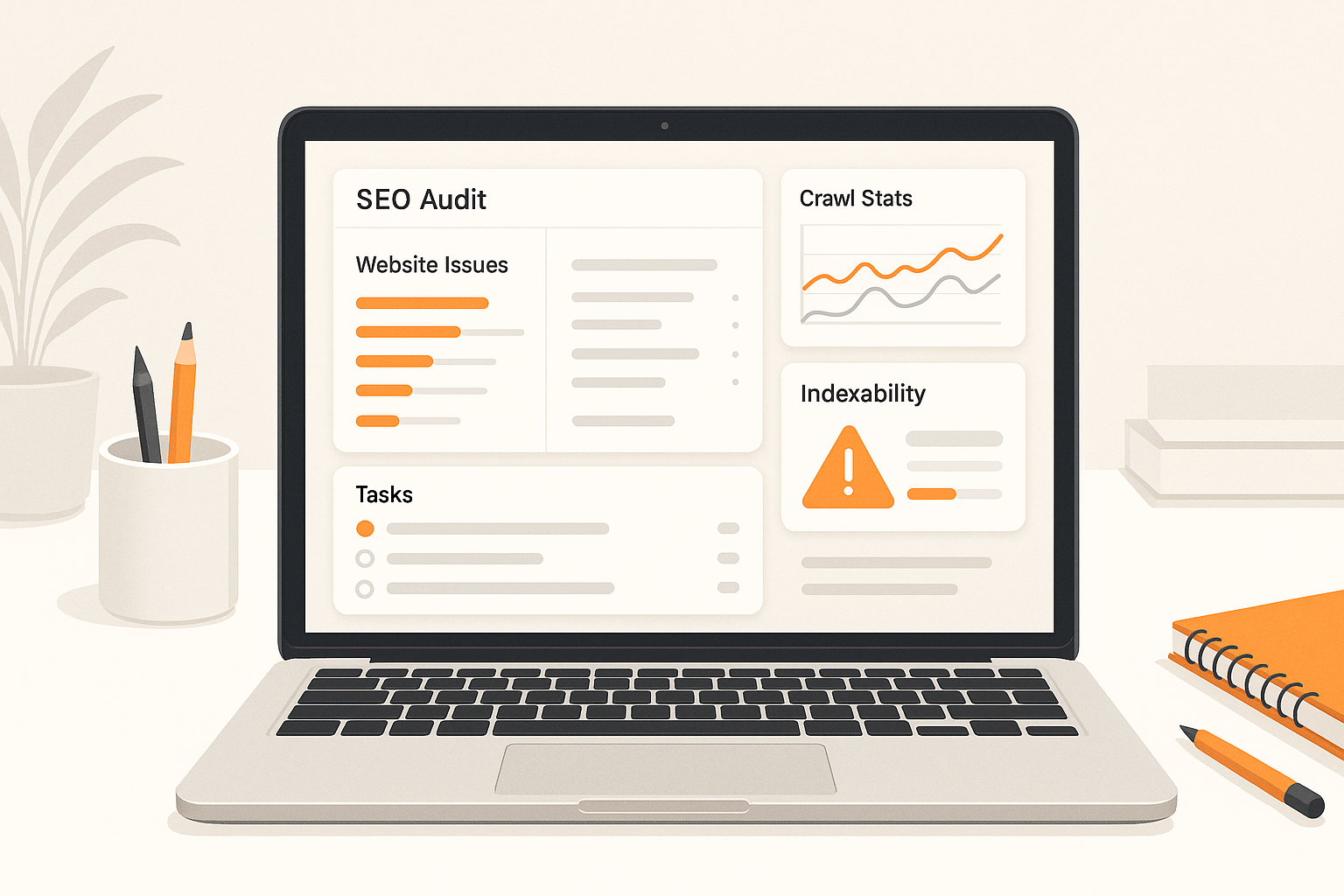

Good SEO audit software can save time, surface critical technical issues, and help teams focus on the fixes that actually move search performance. Bad choices, or bad usage, do the opposite. They flood your backlog with low-value alerts, confuse stakeholders with vague scores, and create the illusion of progress without improving rankings, traffic, or crawl efficiency.
That is why the real question is not whether you need an audit platform. It is whether your SEO audit software helps you make better decisions. The best tools support diagnosis, prioritization, and execution. The wrong ones turn technical SEO into a list of disconnected warnings.
In this guide, we will break down the most common mistakes businesses make when choosing and using audit platforms, what those mistakes cost, and how to build a more useful auditing process from the start.
Why SEO audit software often disappoints
Many teams expect a website audit tool to act like an all-in-one SEO strategy engine. That expectation creates problems. Audit software is extremely useful, but it has limits. It can crawl, flag patterns, and highlight likely issues. It cannot automatically understand business goals, content quality, conversion priorities, or the revenue impact of every technical finding.
Disappointment usually comes from one of two places: choosing software for the wrong reasons, or using good software in the wrong way. In both cases, the outcome is familiar: long reports, little action, and weak alignment between SEO, content, product, and development teams.
A quick view of the biggest mistakes
| Mistake | What goes wrong | Better approach |
|---|---|---|
| Choosing based on feature volume | You pay for complexity you do not use | Match the tool to your site, team, and workflow |
| Treating all alerts as equal | High-impact fixes get buried | Prioritize by business value and severity |
| Ignoring indexability and rendering | Important pages remain invisible to search engines | Focus on crawl access, indexing, and page output |
| Relying on one health score | You optimize the score instead of the site | Review root causes, page groups, and patterns |
| Using generic rules for every site | Recommendations do not fit your architecture | Audit by templates, sections, and SEO goals |
| Running one-time audits only | New issues go unnoticed | Build ongoing site health monitoring |
| Acting on false positives | Teams waste time fixing non-issues | Validate findings before escalation |
| Buying a tool that does not fit operations | Reports never become implementation | Choose strong exports, segmentation, and collaboration |
1. Choosing SEO audit software based on the number of checks
A long checklist can look impressive in a sales page or demo, but more checks do not automatically mean better auditing. Some tools overwhelm users with hundreds of warnings that vary wildly in importance. That creates noise, not clarity.
The most effective SEO audit software is not the one with the longest issue library. It is the one that helps you understand which findings matter for your site. If you run a small content site, your needs differ from a marketplace, a multi-location business, or a large ecommerce catalog. A massive enterprise platform may be unnecessary. A lightweight crawler may be too limited.
What to do instead
- Start with your site type, size, and CMS.
- List the recurring problems you actually need to detect.
- Check whether the tool supports segmentation by templates, directories, or page types.
- Evaluate whether reports are understandable for both SEO and non-SEO stakeholders.
If a platform cannot help your team move from issue detection to implementation, feature volume is a distraction.
2. Treating every issue as equally urgent
This is one of the fastest ways to waste time. Most audit tools flag everything from broken internal links to minor metadata inconsistencies to duplicate headings. Some of those findings deserve immediate attention. Others can wait. Some may not matter at all in your specific context.
When teams treat every alert as a critical failure, the SEO roadmap becomes bloated. Development resources get spent on low-value clean-up while more serious indexability issues, template problems, or internal linking gaps remain unresolved.
What to do instead
Build a prioritization framework around three questions:
- Scope: How many pages are affected?
- Severity: Does the issue block crawling, indexing, or relevance?
- Impact: Does the issue affect important pages, page templates, or revenue-driving sections?
A proper technical SEO audit is not just about finding flaws. It is about ranking fixes by likely business value.
3. Ignoring crawlability, rendering, and indexability
Some teams spend too much time reviewing cosmetic on-page SEO issues while underestimating the fundamentals. If search engines cannot crawl a page properly, render it consistently, or index the correct version, a polished title tag will not solve the real problem.
This is where a capable SEO crawler becomes essential. You need visibility into status codes, canonical patterns, redirect chains, orphan pages, robots directives, noindex usage, duplicate URLs, and inconsistent internal linking. For many sites, these foundational issues create more damage than the smaller recommendations that dominate generic audit summaries.
What to do instead
- Review crawl depth, blocked URLs, and internal discoverability.
- Check indexation rules across templates and parameterized URLs.
- Validate canonicals, pagination logic, and duplicate clusters.
- Look at rendered output when JavaScript affects key elements.
If your audit workflow does not make crawl errors and indexation problems easy to spot, you may be optimizing pages that search engines cannot process correctly in the first place.
4. Letting a site health score drive the conversation
Health scores are useful summaries, not SEO strategies. They can help teams notice deterioration over time, but they should never become the primary goal. A site can improve its score while doing little to strengthen search visibility. It can also have an imperfect score while still performing well where it matters most.
The problem with relying too heavily on a score is that it compresses a complex technical environment into one number. That encourages superficial reporting. Stakeholders hear that the score moved from one level to another, but they do not learn which templates broke, which sections lost internal links, or which pages became non-indexable.
What to do instead
Use scores as directional signals only. Then go deeper:
- Analyze issue trends by directory, template, and page type.
- Separate critical blockers from hygiene tasks.
- Compare changes against releases, migrations, and content updates.
- Track whether fixes improved accessibility to important pages.
The best SEO audit software should make diagnosis easier, not reduce the entire site to a vanity metric.
5. Using the same audit rules for every kind of website
No serious SEO team should apply a generic audit template to every site. A publisher, SaaS company, local service business, and large ecommerce store all have different risks, structures, and performance priorities. Yet many audits still follow a one-size-fits-all checklist.
That leads to irrelevant recommendations and missed opportunities. For example, faceted navigation may be central to one site and a major source of duplication on another. Pagination, filters, location pages, multilingual structures, and inventory changes all require different interpretations. This is especially important when evaluating enterprise SEO tools, which often promise breadth but can still fall short on business-specific configuration.
What to do instead
- Audit key sections separately rather than judging the site as one unit.
- Create different rules or thresholds for blogs, product pages, category pages, and support content.
- Align findings with your traffic model, conversion paths, and editorial goals.
- Prioritize page templates that scale impact, not isolated pages.
A strong website audit tool should support segmentation well enough that your team can act on patterns, not just isolated URLs.
6. Running a one-time audit instead of ongoing site health monitoring
Audit software loses value when it is used like a one-off event. Websites change constantly. New pages are published. Templates are edited. redirects are added. plugins update. Internal links shift. Indexation rules drift. A clean report today does not guarantee a clean site next month.
That is why mature teams treat audits as an operating process, not a quarterly document. Continuous site health monitoring helps you catch regressions earlier, especially after releases, migrations, structural changes, or content expansion.
What to do instead
- Schedule recurring crawls for high-priority sections.
- Track issue trends over time rather than isolated snapshots.
- Review changes after deployments, redesigns, or CMS updates.
- Set escalation rules for critical failures such as blocked sections, broken canonicals, or large spikes in errors.
The right SEO audit software should support ongoing operational visibility, not just produce a PDF once in a while.
7. Accepting every flagged issue without validation
Audit tools are extremely helpful, but they do not interpret context perfectly. False positives happen. Low-priority issues appear more serious than they are. Some checks are based on generalized best practices that may not fit your site architecture. If you send every flagged item to developers without review, trust erodes quickly.
This is especially common with duplicate content alerts, heading structure warnings, thin content assumptions, and parameterized URLs. A tool may detect a pattern accurately but frame its severity poorly. Or it may flag a legitimate technical setup as a problem because the rule is too rigid.
What to do instead
- Validate a sample of URLs before escalating sitewide tickets.
- Cross-check findings against search console data, logs, and live rendering where possible.
- Distinguish between standards violations and real SEO risks.
- Document which alerts your team treats as actionable, informational, or ignorable.
A disciplined audit process protects your development backlog from noise and helps SEO maintain credibility.
8. Overlooking reporting, workflows, and handoff quality
Even strong technical findings fail if the software cannot support execution. This is where many buying decisions go wrong. Teams focus on crawl capability but ignore whether the platform makes it easy to share tasks, export segmented reports, explain severity, or compare changes between crawls.
In practice, audit success depends on operational fit. Can your team isolate issues by template? Can product managers understand the recommendation? Can developers reproduce the problem quickly? Can stakeholders see which fixes are complete and which require follow-up?
What to do instead
- Test exports and filtered reporting before you commit.
- Check whether issues can be grouped into implementation-ready batches.
- Make sure the platform supports collaboration, not just analysis.
- Choose software that helps you explain why an issue matters, not only that it exists.
The best SEO audit software helps bridge the gap between technical discovery and business action.
How to evaluate SEO audit software more intelligently
If you are comparing platforms, keep the evaluation grounded in practical use cases. Ask the following:
- Can the tool crawl the scale and complexity of our site?
- Does it surface crawl errors, duplication patterns, redirects, canonicals, and internal linking issues clearly?
- Can we segment results by directory, template, or page type?
- Does it support recurring audits and historical comparisons?
- Are reports useful for both SEO specialists and implementation teams?
- Will it help us prioritize fixes, not just discover them?
If the answer to the last question is weak, the software may create more work than value.
Choose software that improves decisions, not just diagnostics
Ultimately, the purpose of SEO audit software is not to generate a longer issue list. It is to help you protect search visibility, uncover technical obstacles, and make better prioritization decisions across the site. That requires context, validation, and repeatable workflows.
If you want a cleaner, more actionable approach to technical SEO, explore Rabbit SEO. The right platform should help you move from raw findings to clear next steps, so your team can spend less time sorting reports and more time fixing what matters.
Final thoughts on SEO audit software
The biggest mistakes with SEO audit software are rarely technical. They are strategic. Teams buy tools for the wrong reasons, trust summary scores too much, chase low-impact alerts, and forget that a good audit only matters if it leads to useful action. Avoid those mistakes, and your audit process becomes far more valuable: clearer priorities, stronger technical hygiene, and a site that is easier for search engines to crawl, interpret, and rank.