
The fastest way to improve SEO for ecommerce is not to chase isolated tricks. It is to study the mistakes that keep reappearing across audits, redesigns, recovery projects, and growth-focused case studies. Different stores, different platforms, different catalog sizes, yet the same patterns show up again and again.
When ecommerce sites struggle to grow organic traffic, the issue is rarely a single missing tactic. More often, it is a structural weakness: category pages with no real relevance signals, product templates that create duplication at scale, filter systems that explode the number of crawlable URLs, or internal linking that leaves high-value pages buried too deep to perform.
This is why the category for this article matters. In case studies, what stands out is not novelty. It is repetition. The stores that underperform usually share the same avoidable errors, and the stores that recover do so by fixing fundamentals in the right order.
If you want a sharper ecommerce SEO strategy, start by removing the blockers that prevent your best commercial pages from being discovered, understood, and ranked. Below are the most costly mistakes to avoid.
SEO for Ecommerce: a quick diagnostic table
| Mistake | What it hurts | Typical symptom | First priority fix |
|---|---|---|---|
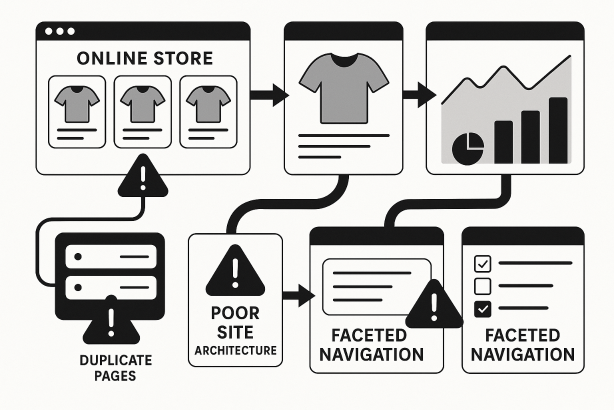
| Poor site architecture | Discovery, relevance, crawl efficiency | Important pages sit too deep | Rebuild category and subcategory hierarchy |
| Weak category pages | Commercial rankings | Blog ranks, collections do not | Improve category page SEO and intent alignment |
| Duplicate product URLs | Index quality, link equity | Variants compete with each other | Standardize canonical URL rules |
| Uncontrolled filters | Crawl budget, index quality | Thousands of low-value URLs | Define faceted navigation SEO rules |
| Weak internal links | Page authority flow | Revenue pages are hard to find | Add contextual and navigational links |
| Index bloat | Site quality signals | Search and filtered pages indexed | Review indexation rules and page states |
The SEO for ecommerce mistakes that case studies repeat
1. Building around products before building around site architecture
Many ecommerce teams start by loading products, choosing collections, and launching design templates. SEO gets layered on later. That approach usually creates a store that works operationally but not search-wise. Categories overlap, subcategories are inconsistent, and key pages end up too deep in the click path.
In case study reviews, this is one of the most common root causes because architecture influences almost everything else: keyword targeting, internal linking, crawl paths, canonical logic, breadcrumb trails, and how clearly search engines can understand your inventory.
A strong SEO for ecommerce setup begins with a hierarchy that mirrors real search demand. Top-level categories should map to broad commercial intent. Subcategories should narrow by product type, use case, or other meaningful distinctions. If the structure is unclear to users, it will usually be unclear to search engines too.
- Keep important categories close to the homepage.
- Avoid overlapping taxonomy where multiple pages target the same query theme.
- Use breadcrumbs to reinforce hierarchy and internal relevance.
2. Targeting keywords without matching search intent
Ecommerce keyword research often goes wrong when teams collect terms by volume instead of intent. A keyword may look attractive, but that does not mean a product page or category page should target it. Some terms want buying options, some want comparisons, and some want education first.
This mistake creates a familiar pattern: stores publish category pages for informational queries or write blog posts for clearly transactional terms. The result is weak relevance on both sides. The page type does not match the searcher’s expectation.
Good category page SEO starts with intent classification. Ask a simple question for every target keyword: should this term land on a category, subcategory, product page, guide, comparison article, or FAQ? Once that mapping is correct, optimization becomes much easier.
A useful rule is this: broad shopping terms typically belong on category pages, highly specific model or SKU terms belong on product pages, and pre-purchase research terms belong in supporting content that links back into commercial pages.
3. Underinvesting in category pages while overinvesting in the blog
Blogs matter, but many ecommerce sites use content marketing as a substitute for fixing weak category pages. That usually leads to a traffic profile that looks healthy on the surface yet underperforms commercially. Informational pages attract visits while the pages closest to revenue fail to rank well enough.
Across ecommerce case studies, one recurring lesson is that category pages deserve far more editorial attention than they often receive. A category page is not just a product grid. It is a commercial landing page. It should have a clear targeting purpose, strong headings, helpful introductory copy, refined filters, well-organized products, and supportive internal links.
When category templates are thin, repetitive, or generic, they struggle to compete. The fix is not stuffing more text at the bottom. It is making the page genuinely useful:
- Write concise, intent-led introductory copy near the top.
- Use clear subcategory and related-category links.
- Include FAQs or selection guidance where relevant.
- Make the page easy to scan and easy to refine.
4. Letting faceted navigation create an SEO mess
Faceted navigation SEO is one of the most misunderstood parts of ecommerce. Filters improve usability, but they can also create a huge number of low-value URLs. If color, size, price, brand, material, and sort options all generate crawlable combinations, search engines can spend time on pages that should never compete in search.
This is a common source of technical debt in technical SEO for ecommerce. It can dilute authority, create duplication, and make it harder for priority pages to stand out. The answer is not to remove filtering. It is to control which combinations deserve indexation and which should remain for users only.
Set clear rules. Some filtered pages may deserve landing-page treatment if they map to meaningful demand. Most should not. Separate UX needs from SEO needs, and do not allow platform defaults to make that decision for you.
- Identify high-value filter combinations with real search intent.
- Keep non-strategic filter URLs out of the index.
- Be consistent with canonicals, internal links, and crawl directives.
5. Publishing thin or duplicate product pages at scale
Product page SEO often suffers from scale problems. The larger the catalog, the easier it is to fall into duplicate copy, near-identical variant pages, manufacturer descriptions, and weak differentiation across similar products. On smaller stores, this may look manageable. At scale, it becomes a site-wide quality issue.
Product pages do not need to read like long-form articles, but they do need unique value. Search engines and shoppers both need enough detail to understand what makes one item distinct from another. If every page uses the same template, the same headings, and the same recycled wording, differentiation disappears.
Common problems include:
- Separate URLs for minor variants when one parent product page would be cleaner.
- Copied supplier descriptions that appear on many other sites.
- Thin pages for discontinued, seasonal, or low-priority items.
The practical fix is to define product-page rules by product type. Not every SKU needs the same level of content, but your most important pages should have unique copy, clear specifications, strong media, helpful FAQs, and connections to related categories or guides.
6. Treating internal linking as an afterthought
Internal linking for ecommerce is often weaker than it should be because teams rely too heavily on menu navigation and breadcrumbs alone. Those elements help, but they are not enough to push authority and context toward the pages that matter most.
Case study patterns show that ecommerce sites frequently have valuable pages sitting in isolation. A strong category may receive links from the menu, yet no supporting content points toward it. A useful buying guide may get organic traffic, but it does not guide users into the relevant commercial paths. A product line may exist across several subcategories with no curated cross-links.
Good internal linking should connect three layers of the site:
- Top-level categories and subcategories
- Editorial content and commercial pages
- Related products, accessories, alternatives, and bundles
This improves discovery, distributes authority more efficiently, and helps search engines understand page relationships. It also improves the customer journey, which is the point many SEO plans miss.
7. Allowing index bloat from search pages, out-of-stock pages, and outdated URLs
Not every page on an ecommerce site should be indexed. Yet many stores allow internal search results, parameterized URLs, temporary filtered pages, and low-value product states to remain accessible to search engines with no real strategy behind them.
This creates index bloat: too many low-value pages competing for attention and weakening the overall quality of the indexable site. One of the clearest recurring lessons from recovery work is that cleaning up indexation often matters as much as creating new content.
Pay special attention to page states:
- Out of stock: keep pages live if the product is expected back and the page has value.
- Discontinued: redirect when a close replacement exists, or retain the page with helpful alternatives if it still serves users.
- Internal search pages: usually not a target for indexing.
- Expired campaign URLs: avoid leaving them to accumulate.
Indexation is a quality decision, not just a technical setting.
8. Relying on template-level metadata and generic copy
Templates are essential in ecommerce, but template thinking can flatten relevance. When hundreds of pages use near-identical title tags, meta descriptions, headings, and intro copy, the site stops sending strong page-level signals.
This is especially damaging on categories and subcategories, where nuance matters. A page targeting a broad product class should not look identical to a page targeting a narrower use case or audience. Yet in many stores, the difference is little more than a swapped keyword in the H1.
Better template systems create structure without erasing specificity. Build reusable frameworks, but customize strategically for high-priority pages. That may include:
- Distinct title tags based on search intent and page purpose
- Page intros that explain the category rather than repeat the keyword
- Unique supporting modules such as FAQs, buying tips, or related collections
The goal is not manual writing for every URL. It is enough editorial variation to make key pages meaningfully different.
9. Ignoring structured data and search-result presentation basics
Structured data does not replace fundamentals, but ignoring it is still a mistake. Ecommerce pages should help search engines understand core elements such as products, pricing, availability, reviews where appropriate, and site hierarchy. Even when richer results are not guaranteed, clearer page interpretation is still valuable.
This area often gets delayed because it feels technical rather than strategic. In reality, it sits between both. Search presentation affects click quality, and clean markup supports better understanding of commercial pages.
Just be careful not to treat markup as a shortcut. If the underlying page is thin, duplicate, or poorly targeted, adding structured data will not solve the real problem. Use it to reinforce a solid foundation, not to compensate for a weak one.
10. Redesigning or migrating without an SEO preservation plan
Among the most damaging case study patterns is the avoidable traffic loss that follows a redesign, replatform, or URL restructure. Teams focus on speed, branding, and launch deadlines, while SEO preservation gets pushed into the final checklist. By then, the risky decisions have already been made.
Migration-related losses usually come from familiar failures: changed URLs without proper redirects, deleted content with no replacement strategy, altered internal linking, broken canonicals, thinner templates, or navigation changes that demote previously strong pages.
If a redesign is coming, SEO for ecommerce should be part of planning from the start, not cleanup afterward. At minimum, protect these areas:
- URL mapping and redirects
- Retention of high-performing content elements
- Canonical and metadata integrity
- Navigation and internal linking continuity
- Post-launch crawl and indexation checks
Many losses blamed on algorithms are actually migration mistakes.
How to prioritize ecommerce SEO fixes like a case study editor
One reason stores stay stuck is that they try to fix everything at once. The better approach is to prioritize in the same sequence that strong case studies usually reveal after the fact.
- Start with architecture and indexation. If the site is hard to crawl or cluttered with low-value URLs, later improvements will underperform.
- Then strengthen category pages. These are usually the highest-leverage commercial assets for non-brand organic growth.
- Next, clean up product-page duplication and template issues. This improves page quality at scale.
- After that, improve internal linking. This helps distribute authority to the pages you have just improved.
- Finally, expand supporting content. Use guides, comparisons, and FAQs to support commercial intent, not distract from it.
This order matters because it turns SEO from a list of tasks into a coherent system. That is what the best ecommerce recoveries have in common: not more activity, but better sequencing.
Need a clearer SEO for ecommerce roadmap?
If your store has strong products but inconsistent organic performance, the issue is often not effort. It is prioritization. Rabbit SEO can help you identify the structural mistakes holding back your categories, products, and crawl efficiency, then turn those findings into a practical action plan your team can execute.
If you want a focused audit that cuts through noise and highlights the fixes most likely to improve revenue-driving visibility, Rabbit SEO is a smart next step.
Conclusion: better SEO for ecommerce starts with fewer avoidable mistakes
The most important lesson from recurring case study patterns is simple: sustainable SEO for ecommerce is usually won or lost in the fundamentals. Clear architecture, intent-led category pages, disciplined indexation, strong product differentiation, and smarter internal linking beat reactive optimization every time.
Before you publish more content, add more apps, or chase new tactics, review the mistakes above. If your store avoids them, your future SEO work gets easier. If your store still suffers from them, fixing them will likely create more value than any trend-driven shortcut ever could.