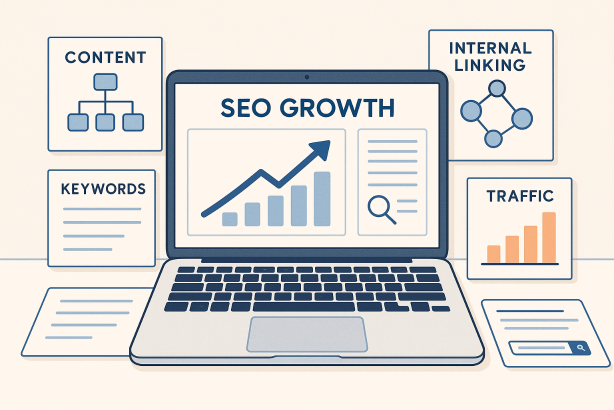

SEO for ecommerce works best when it is treated as an operating system, not a one-off project. Stores grow quickly, catalogs change constantly, products go out of stock, filters create new URLs, and merchandising decisions can help or hurt search performance overnight. That is why a workflow matters. It gives your team a repeatable way to identify opportunities, fix issues, publish improvements, and measure what actually moves revenue-oriented organic traffic.
This guide lays out a practical, scalable workflow for SEO for ecommerce. It is designed for teams that need structure: founders managing a single store, in-house marketers juggling dozens of priorities, and ecommerce operators trying to align SEO with development, content, and merchandising. The goal is simple: make SEO predictable enough to run every week without losing sight of long-term growth.
Why ecommerce SEO needs a workflow
Most SEO problems on ecommerce sites are not isolated problems. They are recurring patterns. The same template issues affect thousands of product URLs. The same internal linking gaps weaken whole category clusters. The same duplicate-content risks appear every time faceted navigation expands. If you approach these issues page by page, progress will always be slow.
A workflow changes that. Instead of reacting to whatever looks urgent, you work in a fixed sequence:
- Protect crawl efficiency and index quality so search engines can focus on your highest-value pages.
- Map search intent to the right page types so categories, subcategories, products, and content do not compete with one another.
- Optimize templates, not just individual pages to create leverage across the catalog.
- Use internal linking and merchandising logic to strengthen important commercial pages.
- Review performance on a cadence so the next sprint is based on evidence, not guesswork.
That is the difference between random activity and a real ecommerce SEO strategy.
Before you start: define goals, ownership, and page priorities
Before any audit or optimization work begins, decide what success means for the business. For some stores, the main objective is non-brand traffic growth to category pages. For others, it is improving visibility for high-margin collections or lifting underperforming product lines. Your workflow should reflect commercial priorities, not just SEO theory.
Start with three decisions:
- What page types matter most? Usually this means category pages first, then high-priority products, then supporting editorial content.
- Who owns implementation? Separate strategy from execution. Clarify who handles technical changes, who updates content, and who signs off on merchandising changes.
- What is the source of truth? Keep one working document or project board that tracks issues, priority, status, and expected impact.
Without this layer of operational discipline, even strong SEO recommendations tend to stall.
Step 1: Build your technical baseline
Technical SEO for ecommerce is the foundation of the workflow because no amount of content or keyword targeting can compensate for weak crawl paths, index bloat, or broken templates. The technical pass does not need to be endlessly complex, but it does need to be systematic.
What to review first
- Indexation: Are only valuable, canonical pages eligible for indexing, or are search engines wasting attention on parameter URLs, internal search pages, and thin variations?
- Canonical logic: Do canonicals consistently point to the preferred URL version for products, categories, and filtered pages?
- Site performance: Are core templates reasonably fast and stable on mobile devices, especially category and product pages?
- Status codes: Look for broken internal links, redirect chains, orphaned pages, and soft-404 patterns from expired products.
- Structured data: Make sure product and breadcrumb markup is present, accurate, and aligned with visible page content.
- XML sitemaps: Include indexable priority pages and keep low-value URLs out.
The purpose here is not to chase every minor warning. It is to remove the technical friction that prevents important commercial pages from being crawled, understood, and ranked.
Step 2: Map keywords to the right page type
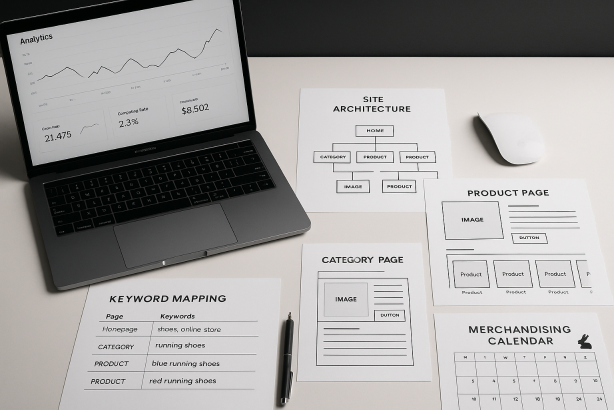
Ecommerce keyword research is often mishandled because teams collect terms without deciding where each query should land. On an ecommerce site, keyword mapping is really an intent-matching exercise. A store usually needs four distinct search destinations: category pages, subcategory pages, product pages, and informational content.
How to assign intent
- Category pages target broad commercial terms with clear shopping intent.
- Subcategory pages target narrower attribute-driven or use-case-driven searches.
- Product page SEO focuses on model-level, branded, or highly specific buying searches.
- Editorial content supports discovery, comparison, care, sizing, compatibility, and pre-purchase questions.
This step prevents cannibalization. If a category page and a blog article are both trying to rank for the same core query, neither will be as strong as it could be. Each important keyword cluster should have a clear primary destination and a supporting internal linking plan.
As you map keywords, build in business context. A lower-volume query tied to a high-margin collection may deserve more attention than a broader term that attracts weaker commercial intent.
Step 3: Strengthen architecture and internal linking
Internal linking for ecommerce is more than adding links in body copy. It is the way your site communicates commercial importance. Strong architecture helps search engines discover priority pages and helps users move naturally from broader categories to more specific product sets.
Review your structure from the top down:
- Can a user and a crawler reach key category pages within a few clicks from the homepage?
- Do subcategories logically support the parent category without overlap and ambiguity?
- Are your best-selling or highest-margin collections surfaced in navigation, breadcrumbs, and contextual modules?
- Do editorial pages link back to relevant categories and products, not just other articles?
A good ecommerce architecture creates reinforcing signals. Category pages link to subcategories. Subcategories link to relevant products. Supporting content links to both. Breadcrumbs reflect real hierarchy. Related-product modules help users continue shopping while expanding crawl paths. This is where SEO and merchandising should work together, not separately.
Step 4: Standardize on-page optimization for scale
On ecommerce sites, consistency often matters more than brilliance. Instead of writing every page from scratch, create standards for each page type. That is how category page SEO and product optimization become scalable rather than chaotic.
Category page essentials
- Title tag: Clear primary keyword plus brand or qualifier when useful.
- H1: Closely aligned with the target query and page purpose.
- Intro copy: Brief, useful text that confirms relevance without pushing products too far below the fold.
- Subcategory links: Visible paths to related collections and attribute-based refinements.
- Supporting copy blocks: Add helpful buying context lower on the page where appropriate.
Product page essentials
- Unique product titles and descriptions that go beyond manufacturer copy.
- Clear specification details that match how shoppers search and compare options.
- Image optimization through descriptive file naming and meaningful alt text where relevant.
- Availability, pricing, and shipping information presented clearly for users.
- Structured data for ecommerce that accurately reflects the product shown on the page.
The main point is to build reliable templates. If your category page standard improves click-through rate and relevance, that improvement can be rolled out across dozens or hundreds of URLs.
Step 5: Control duplication from filters, variants, and thin pages
One of the hardest parts of SEO for ecommerce is knowing which URLs should exist for users but not compete in search. Faceted navigation, variant pages, sort parameters, and session-based URLs can quickly inflate the crawlable footprint of a store.
This is where faceted navigation SEO becomes critical. Your workflow should define which filtered combinations deserve search visibility and which should remain crawl-limited or non-indexable. There is no universal rule, but there should be a clear decision framework based on search demand, uniqueness, and business value.
- Allow indexation for filter combinations only when they represent genuine search demand and produce a useful landing page.
- Consolidate near-duplicate variant pages when a single product page better serves users and search engines.
- Handle out-of-stock and discontinued products with a consistent policy, not ad hoc decisions.
- Remove or improve thin category pages that exist in navigation but offer little standalone value.
This step protects the rest of your workflow. Without index control, strong pages are forced to compete with low-value noise generated by the platform.
Step 6: Publish supporting content that helps products get discovered
Ecommerce content should support commerce. That means fewer generic articles and more assets that help people choose, compare, use, size, maintain, or understand products. Good supporting content expands organic reach while strengthening category and product pages through internal links.
Useful formats include:
- Buying guides tied to category intent
- Compatibility or fit guides
- Comparison pages for closely related products or collections
- Care, maintenance, and setup content
- Seasonal trend pages that connect back to current inventory
The editorial rule is simple: every content piece should support a commercial pathway. If it attracts the right visitor but provides no logical next click into the store, it is not doing enough for the business.
Step 7: Measure performance and prioritize the next sprint
A workflow is only useful if it creates a loop. After each round of implementation, review performance, identify what changed, and feed that insight into the next sprint. Focus on page groups and templates before obsessing over isolated rankings.
| Cadence | What to review | Why it matters |
|---|---|---|
| Weekly | Critical technical issues, newly published pages, indexing anomalies, high-priority keyword movement | Keeps urgent problems from compounding |
| Monthly | Category performance, product visibility, internal linking gaps, top landing pages, page template opportunities | Shows where workflow changes are affecting revenue paths |
| Quarterly | Site architecture, content expansion, seasonal planning, discontinued product handling, taxonomy changes | Aligns SEO with broader merchandising and growth plans |
Use prioritization rules that balance impact, effort, and scale. A small change to a high-volume category template can outperform dozens of one-off page edits. Likewise, resolving a crawl-control problem may unlock more value than publishing several new articles.
A weekly SEO for ecommerce workflow your team can actually run
If you want a practical operating rhythm, use a simple weekly cadence:
- Monday: Review technical alerts, crawl issues, and urgent indexation changes.
- Tuesday: Analyze category and product performance by template, not just by single URL.
- Wednesday: Implement on-page updates for priority categories and products.
- Thursday: Improve internal linking, navigation signals, and supporting content connections.
- Friday: Document results, re-prioritize the backlog, and prepare next week’s implementation list.
This rhythm is intentionally simple. The point is to make SEO for ecommerce repeatable enough that progress continues even during busy commercial periods.
Common mistakes that slow down ecommerce growth
- Treating every page the same: Category pages, product pages, and content pages serve different intents and need different optimization standards.
- Letting filters create uncontrolled index bloat: More URLs do not mean more opportunities if most of them are weak or duplicative.
- Writing content without a commercial path: Informational traffic is useful only when it supports discovery and conversion journeys.
- Ignoring internal linking: Great pages often underperform simply because the site does not signal their importance clearly enough.
- Working without a cadence: If SEO happens only when time allows, the store will always be reacting instead of compounding gains.
Turn SEO for ecommerce into a growth system
The stores that win in organic search are rarely the ones doing the most random activity. They are the ones with the clearest system. They know which page types matter, how keywords map to the site, how templates should perform, and how each sprint feeds the next one. That is what makes SEO for ecommerce sustainable.
If you want a more organized way to run that process, visit Rabbit SEO and explore how we help ecommerce teams turn search visibility into a repeatable workflow. The right system makes it easier to prioritize what matters, execute consistently, and keep improving the pages that drive real commercial value.
In the end, strong SEO for ecommerce is not about chasing isolated wins. It is about building a disciplined workflow that keeps technical health, relevance, architecture, and commercial intent moving in the same direction.