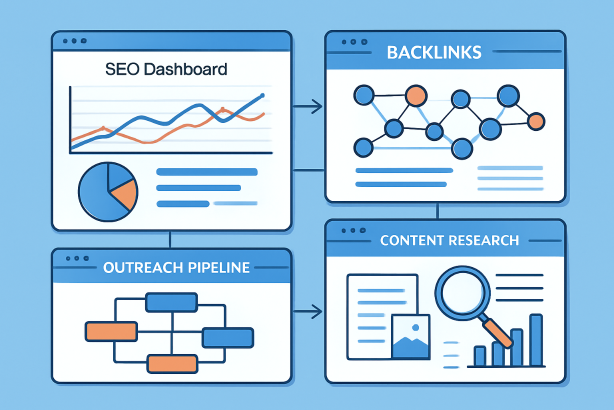

Choosing the right SEO software can turn link building from a scattered set of tasks into a repeatable growth process. Instead of chasing random opportunities, you can use software to find the right websites, assess link quality, organize outreach, and monitor results over time.
In this step-by-step tutorial, you will learn how to use SEO software for link building in a practical way. The focus is not on vanity metrics or one-off wins. It is on building a workflow you can repeat every month: research, qualify, outreach, track, and improve.
If you are responsible for organic growth, content promotion, or digital PR, this guide will help you create a cleaner system for acquiring relevant backlinks that support rankings and traffic.
Why SEO software matters in link building
Link building involves many moving parts. You need to know which pages deserve links, which competitors are earning them, which domains are worth contacting, and how your backlink profile changes over time. Trying to manage all of that in browser tabs and spreadsheets alone quickly leads to missed opportunities.
Good SEO software helps you:
- Run structured backlink analysis on your site and competitors
- Discover realistic link opportunities through competitor backlink research
- Build and filter lists for link prospecting
- Review referring domains and page relevance before outreach
- Plan better anchor-to-page matches with anchor text analysis
- Track new, lost, and existing backlinks after backlink outreach
The result is not just more efficiency. It is better decision-making. In link building, quality judgment matters as much as activity volume.
Before you start: define what the campaign should achieve
Before opening any tool, set the goal of the campaign. This step is often skipped, but it determines how you use the software and what opportunities you prioritize.
Ask four simple questions:
- Which pages need links most?
- What business topics should the campaign support?
- What type of links are realistic for your site right now?
- How will you judge whether a prospect is worth outreach?
For most teams, the best pages to support are one of the following:
- High-conversion commercial pages that need authority
- In-depth guides or resources that are naturally linkable
- Original category pages with strong topical relevance
- New content that needs discovery and promotion
Write down your target pages and the topics connected to them. This becomes the foundation for the rest of the workflow.
Step 1: Choose SEO software based on workflow, not hype
Not every platform fits the same link building process. Some tools are stronger in prospect discovery, others in monitoring, and others in project organization. When evaluating SEO software, focus on whether it supports the steps you actually need to perform every week.
Core features to look for
- Backlink index: You need enough coverage to review competitor links and your own profile with confidence.
- Domain and page-level analysis: The software should let you assess relevance, authority signals, and linking patterns.
- Competitor comparison: This is essential for identifying link gaps and repeated placements in your niche.
- Filtering and segmentation: You should be able to sort prospects by topic, type, status, and quality.
- Backlink monitoring: New links, lost links, and changes in referring pages should be easy to track.
- Project management support: Notes, tagging, exports, or integrations help move research into outreach.
A simple rule applies here: the best link building software is the one that helps your team move from research to action with minimal friction.
Step 2: Set up your project and establish a baseline
Once you have the software in place, create a project for your site or campaign. Add your domain, import or identify your priority pages, and label the campaign by topic or business objective.
Now record a baseline before you begin outreach. You do not need complex reporting. You just need a clear starting point so that later improvements are easy to interpret.
| Baseline item | What to note | Why it matters |
|---|---|---|
| Target pages | Pages you want to strengthen | Prevents link equity from being spread too thin |
| Current backlinks | Existing links to those pages | Shows where each page stands today |
| Referring domains | Unique domains linking to each page | Helps identify pages that need broader support |
| Anchor text patterns | Current anchor diversity | Guides safer and more natural link targets |
| Competitor overlap | Domains linking to competitors but not you | Reveals immediate prospect opportunities |
This baseline turns your software into a decision system rather than a dashboard you check occasionally.
Step 3: Run competitor backlink research to find real opportunities
This is where SEO software becomes especially valuable for link building. Start by identifying three to five competitors that rank for the same topics or pages you are targeting. Avoid only looking at the biggest brands. Include competitors with content formats and positioning similar to yours, because their links are often more attainable.
Open each competitor’s backlink profile and look for patterns:
- Resource pages that link to multiple companies in your space
- Editorial articles mentioning tools, guides, or expert opinions
- Guest contribution sites relevant to your niche
- Roundups, directories, or industry associations
- Broken or outdated references that could be replaced
Your goal is not to copy every link. Your goal is to discover which domains repeatedly link to content like yours and what kind of content they prefer to cite.
What to save from competitor research
- The linking domain
- The exact referring page
- The competitor page receiving the link
- The context of the mention
- The likely reason the link was earned
That final point is crucial. A prospect is far more useful when you understand why the link existed in the first place. Was it a source citation, a product recommendation, a partnership mention, or a broken replacement? That context will shape your outreach later.
Step 4: Build a prospect list with intent, not volume
After competitor research, start creating your prospect list. This is the stage where many campaigns lose focus. Teams collect hundreds of domains, but most of them are too broad, too weak, or too irrelevant to matter.
Use your software and manual review together. Software is excellent for surfacing opportunities, but human judgment should decide who makes the final list.
How to organize prospects
- High priority: Strong topical relevance, clear editorial fit, realistic contact path
- Medium priority: Relevant but requires more tailoring or stronger asset positioning
- Low priority: Weak fit, low confidence, or limited value even if acquired
As you sort opportunities, categorize them by type:
- Resource page
- Blog editorial mention
- Listicle or roundup
- Partner or community listing
- Broken link replacement
- Unlinked brand mention follow-up
This structure makes your link prospecting process much easier to manage and prevents generic outreach.
Step 5: Qualify every referring domain before outreach
A large prospect list is not the goal. A qualified list is. Before you contact anyone, review each domain for quality and fit.
Look at these factors:
- Topical relevance: Is the site genuinely connected to your subject area?
- Editorial standards: Does the site publish real content with a clear audience?
- Outbound link behavior: Does the page link naturally, or does it appear overloaded with promotional links?
- Traffic intent: Would a link here make sense for a user, not just a crawler?
- Freshness: Is the site active, maintained, and still publishing?
Most SEO software can help you screen prospects faster, but the final decision should be based on relevance and editorial sense. In link building, a smaller list of well-chosen domains usually outperforms a larger list of weak ones.
Step 6: Match target pages and anchor plans carefully
Once you know which sites you want to contact, map each prospect to the page on your site that best deserves the link. This is where many campaigns improve dramatically. Instead of always pushing the homepage or the same money page, align each outreach target with the most natural destination.
For example:
- A resource page may fit a deep educational guide
- A product comparison article may fit a commercial landing page
- An industry trends article may fit original research or thought leadership content
Use anchor text analysis to review the anchors your pages already have. This helps you avoid overusing exact-match phrasing and encourages a more natural mix of branded, descriptive, and topical anchors.
A simple anchor framework looks like this:
- Branded: Your company or product name
- Descriptive: A phrase describing the resource
- Partial topical: A natural variation related to the target topic
- Generic: Neutral phrasing when context already explains the destination
The purpose is not to script anchors rigidly. It is to understand what would look natural if a real editor decided to link.
Step 7: Create the right outreach angle for each opportunity
Now turn research into outreach. The strongest backlink outreach is based on fit, not pressure. If your email feels mass-produced, your response rate will suffer no matter how good the prospect list looks.
Use the context you captured earlier to shape your angle. Common outreach angles include:
- Suggesting a relevant guide or resource for an existing article
- Offering a replacement for an outdated or broken reference
- Providing additional context for a page that already covers your topic
- Following up on an unlinked brand or product mention
- Sharing a useful asset that fills a specific gap on their page
What to include in outreach notes inside your software or spreadsheet
- The reason this site is a fit
- The page you want them to review
- The article or page you are contacting them about
- The angle you will use
- The status of contact and follow-up
These notes make future communication cleaner and prevent duplicate or inconsistent pitches.
Step 8: Prioritize execution and track outreach status
Once your outreach starts, keep your campaign structured. Whether your SEO software includes built-in workflow tools or you use a simple external tracker, every prospect should move through a clear status pipeline.
A practical outreach pipeline:
- Not contacted
- Prepared for outreach
- Sent
- Follow-up scheduled
- Responded
- Link acquired
- Declined or closed
This is more than project hygiene. It shows you where the campaign is slowing down. If you have many prepared prospects but few sent emails, your execution process needs attention. If many prospects respond but few links are secured, your asset or angle may need improvement.
Step 9: Monitor backlinks, lost links, and link quality over time
Link building does not end when a link goes live. Use your SEO software to monitor new links, detect lost ones, and review whether the final placement matches expectations.
Check for:
- Whether the link is live on the agreed page
- Whether the destination URL is correct
- Whether the context around the link remains relevant
- Whether the domain continues to look trustworthy over time
- Whether valuable links disappear and need recovery follow-up
This monitoring stage matters because campaigns often leak value quietly. Pages get updated. URLs change. Mentions are removed. Tracking your referring domains regularly helps you protect the links you worked to earn.
Step 10: Review what worked and improve the next round
At the end of each campaign cycle, review the process in your software and notes. Focus on patterns, not vanity reporting.
Useful questions to ask:
- Which prospect types converted best?
- Which content assets attracted the most interest?
- Which target pages were easiest to support naturally?
- Where did outreach stall?
- Which competitors still have strong link gaps you have not addressed?
This is how you turn link building into a system. Each round of research and outreach gives you better inputs for the next one.
Common mistakes when using SEO software for link building
Even strong teams can waste time if they use software without a clear method. Watch for these common mistakes:
- Overvaluing raw metrics: A relevant site with editorial integrity is often more useful than a bigger number with weak fit.
- Prospecting without page strategy: If you do not know which page deserves links, outreach becomes unfocused.
- Copying competitor links blindly: Not every competitor backlink is worth replicating.
- Ignoring anchor balance: Repetitive, overly optimized anchors create unnecessary risk.
- Failing to monitor: Acquired links can change or disappear if you never review them.
The software is there to support judgment, not replace it.
A practical weekly workflow you can repeat
If you want a simple operating model, use this weekly rhythm:
| Day or phase | Main action | Primary output |
|---|---|---|
| Research block | Review competitors and identify new prospects | Fresh prospect list |
| Qualification block | Check relevance and editorial fit | Prioritized outreach targets |
| Mapping block | Assign target pages and link angles | Campaign-ready notes |
| Outreach block | Send tailored emails and schedule follow-ups | Active outreach pipeline |
| Monitoring block | Review new and lost backlinks | Updated campaign status |
| Review block | Analyze outcomes and refine process | Smarter next-round strategy |
This kind of repeatable workflow is where SEO software delivers the most value. It creates consistency, keeps your team aligned, and makes every future campaign easier to scale.
Use Rabbit SEO to make link building easier to manage
If you want a simpler way to organize your link building workflow, Rabbit SEO can help you move from research to action more efficiently. Use it to keep your campaign organized, review backlink opportunities, monitor progress, and stay focused on the pages and domains that matter most.
For teams that want a more practical approach to SEO software, the goal is not more dashboards. It is a clearer path to better backlinks. Explore Rabbit SEO and build a link building process you can actually maintain.
Conclusion
The best way to use SEO software for link building is to treat it as part of a disciplined process: define goals, study competitors, qualify prospects, map the right pages, run thoughtful outreach, and monitor the links you earn.
When you follow that process, software becomes far more than a research tool. It becomes the operating system behind smarter link building software decisions, cleaner execution, and stronger long-term results. Start with one campaign, refine the workflow, and keep building a backlink profile that is relevant, resilient, and worth the effort.