
When companies ask how to rank higher on Google, they are rarely asking for a single trick. What they usually want is a reliable way to improve visibility, attract better traffic, and turn SEO into a repeatable growth channel. That is where many buying decisions go wrong. Businesses often compare tactics when they should be comparing delivery models.
A great keyword plan will still underperform if nobody implements it well. A strong technical audit will not move Google rankings if fixes sit in a backlog. And a steady publishing schedule will not help much if the content misses search intent. In other words, the question is not only how to rank higher on Google, but also who will do the work, inside what system, and with what level of consistency.
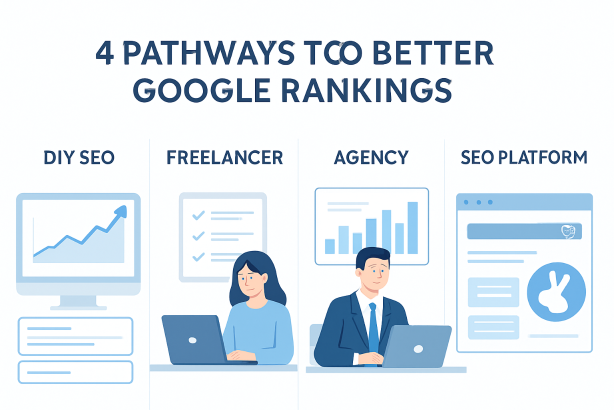
This article takes a commercial comparison approach. Instead of promising a magic formula, it compares the four most common ways businesses try to grow through SEO: doing it yourself, hiring a freelancer, retaining an agency, or using an SEO platform with internal execution. If you are deciding where to invest time and budget, this is the comparison that matters.
How to Rank Higher on Google Starts With the Right Delivery Model
SEO is cumulative. Rankings improve when the right actions happen repeatedly across content, site structure, internal linking, technical SEO, and authority building. That is why the right commercial choice depends less on hype and more on operational fit.
| Option | Best For | Main Strength | Main Limitation |
|---|---|---|---|
| DIY SEO | Founders, very small teams, early-stage sites | Lowest cash cost and full control | Slow execution and steep learning curve |
| Freelancer | Businesses with a defined gap to fill | Flexible expertise and focused support | Limited capacity and single-person dependency |
| Agency | Brands needing strategy plus cross-functional delivery | Broader capabilities and process coverage | Higher cost and risk of generic execution |
| SEO Platform + Internal Team | Teams wanting structure, transparency, and ongoing control | Scalable workflow and clear prioritization | Still requires internal ownership |
The best answer is not universal. A local business with ten key pages does not need the same setup as an ecommerce store with hundreds of categories or a SaaS company publishing bottom-funnel content every week.
What Every SEO Option Must Deliver to Improve Google Rankings
Before comparing providers or platforms, it helps to define what real ranking progress requires. No matter which route you choose, the work must cover the same fundamentals.
- Keyword research: finding terms that match actual customer intent, not just search volume.
- On-page SEO: improving titles, headings, copy structure, relevance, and internal page signals.
- Content optimization: upgrading existing pages and creating new pages that deserve to rank.
- Technical SEO: making sure search engines can crawl, understand, and trust the site architecture.
- Internal linking: connecting pages in ways that help discovery, authority flow, and user navigation.
- Link building: strengthening authority where the market is competitive enough to require it.
- Measurement: tracking changes, learning from results, and adjusting priorities.
If a service sounds attractive but leaves most of these areas vague, it is unlikely to be a serious answer to how to rank higher on Google. SEO is not one deliverable. It is a managed system.
Commercial Comparison: Four Ways Businesses Try to Rank Higher on Google
1. DIY SEO
DIY SEO works best when the site is still small, the niche is not intensely competitive, and the business has someone internally who can learn fast and implement consistently. It is often the right starting point for founders, solo operators, and lean marketing teams that need traction before committing to larger spend.
The main advantage is control. You know the product, the customers, and the commercial priorities better than anyone else. That often leads to sharper page messaging and better alignment between SEO strategy and revenue goals. DIY also forces teams to understand their site structure, conversion pages, and search landscape at a deeper level.
The downside is speed. DIY SEO usually slows down when technical issues appear, when content production must scale, or when competitive gaps require stronger analysis. Many businesses can handle basic on-page SEO and keyword targeting, but fewer can maintain momentum across audits, optimization, publishing, internal linking, and authority building month after month.
Choose DIY if budget is tight and your site is still manageable. Avoid relying on it as a long-term model if your backlog keeps growing faster than your team can execute.
2. Hiring a Freelancer
A freelancer is often the best middle step between doing everything alone and committing to an agency retainer. This route makes sense when you already know the missing piece. Maybe you need technical SEO support, content briefs, a site audit, or a specialist to clean up existing pages.
The commercial appeal is flexibility. A strong freelancer can be sharp, practical, and easier to work with than a larger service team. You often get direct communication with the person doing the work, which helps reduce handoff friction and keeps strategy discussions grounded in reality.
But freelancers vary widely by specialization. Some are excellent at keyword research and content optimization but weaker on implementation. Others are strong technically but less commercial in their page recommendations. Capacity is another issue. A single expert can be brilliant and still become a bottleneck once you need broader execution across content, development, reporting, and ongoing prioritization.
Freelancers are a smart choice when the scope is defined and internal stakeholders can carry part of the load. They are less ideal when your business needs a fully managed SEO system rather than a skilled extra pair of hands.
3. Retaining an SEO Agency
An agency can be the right answer when your site is more complex, your internal bandwidth is limited, or your team needs cross-functional support. In principle, this model offers strategic leadership, technical input, content processes, and accountability inside a single relationship.
The best agencies create leverage. They can bring structured workflows, experienced pattern recognition, and enough bench strength to tackle technical SEO, on-page SEO, and broader content planning at the same time. For businesses with multiple stakeholders, agencies can also help drive momentum by creating regular reporting rhythms and external deadlines.
The risk is standardization. Some agencies deliver real depth; others recycle templates, generic audits, and broad recommendations that look impressive but are hard to execute. Businesses sometimes mistake polished reporting for progress, especially when ownership of implementation is unclear. Another common issue is mismatch between retainers and business reality. If you need agility and close operational collaboration, a rigid monthly package may feel expensive without solving the bottleneck.
If you consider an agency, compare how they prioritize work, how transparent they are, who actually performs the analysis, and whether recommendations map clearly to traffic and revenue pages. A serious agency should make it obvious how its work supports better Google rankings over time.
4. Using an SEO Platform With Internal Execution
The platform-led model is increasingly attractive for companies that want structure without giving away control. This approach pairs software, workflow, and prioritization with an internal marketer, content lead, founder, or growth team that can act on recommendations.
Commercially, this is often the most efficient option for teams that already have some ability to write, edit, or publish but need a stronger system. Instead of paying mainly for meetings and presentations, the budget goes toward visibility, organization, and repeatable execution. Good SEO tools help surface opportunities, keep teams focused on the right tasks, and make progress easier to track.
The key advantage is ownership. Your team keeps the knowledge, the process, and the historical context. Over time, that compounds. Internal teams get better at keyword research, content optimization, and prioritization because the work is happening inside the business rather than around it.
The limitation is simple: software does not replace accountability. If nobody internally owns the plan, even the best platform will underdeliver. But when there is real commitment, a platform-led setup can offer a strong balance of cost control, operational clarity, and scalability.
For many growing businesses, this is the most pragmatic route to answering how to rank higher on Google without becoming overdependent on outside providers.
Which Option Fits Different Business Scenarios Best?
Because SEO outcomes depend heavily on context, the most honest case-study lens is not a fabricated success story. It is a comparison of common business situations and the commercial setup most likely to work in each one.
Local service business
If your site has a focused service area, a limited page set, and clear buyer intent, DIY SEO or a freelancer can go a long way. The priority is usually getting the basics right: service pages, local relevance, on-page SEO, internal linking, and clean site structure. An agency may be more than you need unless competition is intense or the site spans multiple locations.
Ecommerce store
Ecommerce SEO introduces complexity fast. Category architecture, filters, duplicate content risks, product templates, crawl management, and internal linking all matter. In this case, an agency or a platform paired with a capable internal team usually makes more sense than pure DIY. The site has too many moving parts for occasional attention.
Content-led SaaS or B2B brand
If growth depends on publishing targeted pages across problem-aware, solution-aware, and bottom-funnel searches, a platform-led model is often strong. These teams benefit from continuous keyword research, content optimization, and editorial coordination. Agencies can help, but internal ownership is especially valuable because product knowledge and messaging quality directly affect performance.
Multi-location or stakeholder-heavy organization
When approvals involve marketing, development, compliance, and regional teams, process matters as much as expertise. Agencies can help coordinate complexity, but only if they are strong operationally. A platform can also work well here if internal leadership is ready to standardize workflows and maintain accountability across teams.
What to Compare Before You Buy SEO Support
If you are evaluating freelancers, agencies, or platforms, compare them using buying criteria that actually affect outcomes.
- Who owns strategy? You need clarity on who decides priorities and why.
- Who implements recommendations? Advice without execution is delayed value.
- How is success measured? Rankings matter, but page quality, qualified traffic, and commercial page visibility matter too.
- How quickly can changes go live? Slow publishing and development cycles can neutralize good strategy.
- Will you build internal capability? The best investment leaves your team smarter, not just dependent.
- Can the model scale? What works for ten pages may fail at one hundred.
- How transparent is the workflow? You should be able to see the backlog, priorities, and rationale.
These questions cut through polished pitches. They show whether an SEO partner or platform will actually help your team move.
Red Flags That Hurt Rankings Even When the Sales Pitch Sounds Good
- Guarantees about specific rankings: serious SEO providers do not control Google.
- Heavy reporting with light implementation: documents alone do not increase visibility.
- Vague deliverables: if the work plan is unclear, the outcomes usually are too.
- One-size-fits-all retainers: your website type should shape the plan.
- No discussion of technical SEO: even content-led strategies need sound foundations.
- No process for content optimization: ranking higher often comes from improving what already exists, not only publishing more.
In commercial terms, the wrong SEO purchase is costly not only because of fees, but because it delays learning and compounds missed opportunities.
Want a more practical route to how to rank higher on Google? Rabbit SEO is built for teams that want structured SEO workflows, clearer prioritization, and ongoing visibility into what to fix next. If you already have internal publishing or marketing capacity, Rabbit SEO can help turn scattered SEO efforts into a system your team can own and scale.
Final Verdict on How to Rank Higher on Google
There is no single best answer to how to rank higher on Google because businesses do not start from the same place. DIY SEO is efficient for simple sites and early traction. Freelancers work well for defined gaps. Agencies make sense when complexity and coordination are the real obstacles. Platforms are strongest when you want repeatability, transparency, and long-term internal control.
The smart commercial decision is the one that matches your website complexity, team capacity, and speed of execution. If you choose the right model, the usual SEO tactics become far more effective. If you choose the wrong one, even good advice struggles to translate into growth.
Ranking higher on Google is not just about knowing what to do. It is about building a delivery system that makes the right work happen consistently.