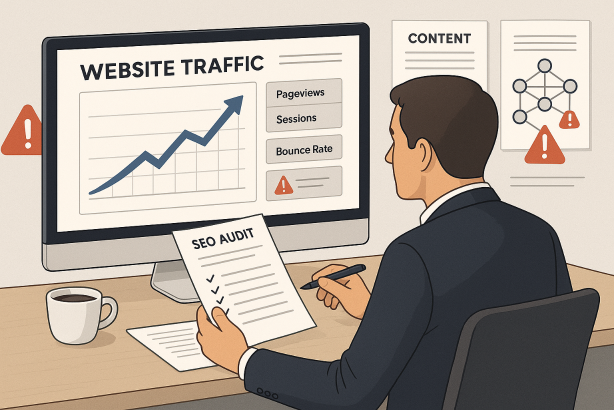

Most teams do not struggle with effort. They struggle with sequence. That is why AI visibility SEO is less about adding random optimizations and more about building a workflow that connects research, information architecture, on-page decisions, and technical control. When those parts move in isolation, visibility becomes inconsistent. Pages overlap. Important topics stay thin. Internal links do not reinforce priority pages. Technical signals send mixed messages. The result is not a single catastrophic error. It is a stack of small misses that weaken discoverability and authority.
This guide takes a case-study approach to that problem. Not by inventing a dramatic turnaround story, but by showing the operating pattern behind successful execution. If you want a repeatable process your content, SEO, and web teams can actually run, this is the model. Use it to diagnose where visibility breaks, decide what to fix first, and turn SEO from a backlog of disconnected tasks into a system.
Why AI visibility SEO needs a workflow, not a checklist
Checklists are useful, but they do not create momentum by themselves. A team can complete keyword research, publish new pages, add schema, and still fail to improve because the tasks were not ordered around a clear objective. AI visibility SEO works best when every step answers a simple question: what signal are we trying to strengthen, and what dependency must be resolved before the next action matters?
For example, expanding content before cleaning up page overlap often creates more confusion, not more reach. Adding internal links before clarifying page hierarchy turns links into noise. Updating title tags on pages that do not satisfy intent may improve click potential but not long-term rankings. Workflow matters because search performance is cumulative. Strong visibility comes from aligned signals, not isolated wins.
In case-study terms, the programs that improve consistently usually share three traits:
- Clear page roles: each URL has a defined job in the wider topic architecture.
- Deliberate coverage: core topics, supporting entities, and decision-stage questions are mapped before production begins.
- Operational feedback: performance data leads to revisions, consolidation, or expansion instead of sitting in dashboards.
The case-study pattern behind weak visibility
When SEO programs plateau, the visible symptom is often declining reach or unstable rankings. The real problem is usually structural. Across underperforming content estates, the same pattern appears again and again: teams produce assets without a governing model for how topics, pages, and authority should compound.
Here are the most common failure points:
- Intent compression: one page tries to serve awareness, comparison, and conversion all at once.
- Topic fragmentation: similar articles compete for the same query space without a clear primary page.
- Weak entity coverage: the site mentions important concepts but does not explain them in enough depth or context.
- Internal linking drift: links are added opportunistically instead of reinforcing priority clusters.
- Technical leakage: duplicate versions, thin archives, and crawl waste dilute important URLs.
- No refresh logic: old pages remain live but unsupported, outdated, or redundant.
This is why the best category fit for this topic is a case-study mindset. You do not need a flashy before-and-after claim to learn from the pattern. The lesson is operational: sustainable visibility grows when strategy, publishing, and technical governance are treated as one system.
The AI visibility SEO workflow at a glance
| Stage | Primary objective | Main deliverable |
|---|---|---|
| 1. Baseline audit | Identify structural and content gaps | Prioritized issue map |
| 2. Query and intent mapping | Define target demand by page role | Topic cluster brief |
| 3. Entity and topical coverage | Strengthen depth and contextual relevance | Coverage matrix |
| 4. Content architecture | Create clean hierarchy and link flow | Hub-and-support structure |
| 5. Page optimization | Improve clarity, relevance, and conversion support | Updated templates and page briefs |
| 6. Technical validation | Protect crawl, indexation, and canonical signals | Technical SEO checklist |
| 7. Iteration loop | Refresh, consolidate, and expand based on evidence | Monthly action queue |
The value of this workflow is not complexity. It is discipline. Each stage makes the next stage more effective. Skip one, and the later work loses efficiency.
1. Start with a baseline audit that reflects business priorities
Begin by auditing the existing site against revenue relevance, not just traffic potential. That means reviewing which pages support commercial intent, which clusters drive qualified discovery, and which URLs are consuming crawl attention without contributing value. A proper content audit should classify every important page into one of five actions: keep, refresh, consolidate, redirect, or deindex.
At this stage, look for:
- Topic overlap between blog posts, landing pages, and guides
- Thin pages sitting inside important categories
- Outdated claims, broken links, and stale examples
- Template problems affecting headings, metadata, or body structure
- Weak connections between informational content and commercial pages
The output should not be a giant spreadsheet with no owner. It should be a short, prioritized issue map with clear next steps. The baseline tells you where the current architecture is helping visibility and where it is quietly suppressing it.
2. Map query clusters and intent before writing or rewriting
Once the baseline is clear, build topic clusters around search behavior and page role. This is where many teams jump too quickly to keywords. A better approach is to group queries by intent, journey stage, and expected page format. One query set may deserve a deep guide. Another may belong on a comparison page. Another may require a product-led landing page with stronger proof and action paths.
This is the backbone of a sound search visibility workflow. It prevents cannibalization and gives every page a reason to exist. For each target page, define:
- The primary query theme
- Secondary questions and modifiers
- The intent class behind the search
- The best page type to satisfy that intent
- The supporting pages that should link in or branch out
Do this before drafting. When intent is mapped early, editorial and SEO stop pulling in different directions.
3. Expand entity coverage to strengthen topical authority
After intent mapping, review whether your content actually covers the concepts, terms, subtopics, and relationships that a strong page should address. This is where entity SEO and topical authority become practical rather than abstract. You are not stuffing related terms into copy. You are making sure the page explains the topic with enough precision and completeness to deserve visibility.
For a commercial topic, that often means covering definitions, process steps, selection criteria, implementation concerns, common objections, adjacent concepts, and realistic decision factors. It also means linking these ideas to supporting assets elsewhere on the site. A page that mentions a concept without building context around it will rarely carry the same authority as a page inside a fully developed cluster.
Create a simple coverage matrix with the core topic in one column and the necessary supporting entities in another. Then mark which pages explain each one well, which mention it lightly, and which miss it completely. That turns an editorial judgment into an actionable plan.
4. Build content architecture that makes priority obvious
Strong visibility depends on more than good pages. It depends on how those pages work together. Your architecture should show clear hierarchy: pillar pages for broad themes, supporting articles for subtopics, commercial pages for solution-oriented intent, and navigational paths that move users and search engines through the cluster logically.
This is where internal linking strategy becomes a growth lever. Use links to reinforce primary pages, not just to create more connections. Anchor text should be descriptive. Link placement should feel editorially earned. Most importantly, the strongest supporting pages should point consistently to the page you want treated as central.
A clean architecture usually includes:
- One primary URL for each major query theme
- Supporting pages that address subtopics without duplicating the main page
- Contextual links from high-relevance pages into priority commercial URLs
- Taxonomy and navigation rules that avoid dead ends or redundant archives
When teams skip this step, they often publish solid pages into a weak system. Good assets deserve stronger structural support.
5. Optimize pages for clarity, completeness, and conversion support
Page-level optimization still matters, but it works best after the strategic structure is settled. At this stage, review titles, headings, summaries, body flow, media support, internal links, and conversion paths. Make the purpose of the page immediately clear. The introduction should confirm the intent match. The heading structure should help scan depth quickly. The body should move from explanation to evaluation to action in a logical order.
For commercial content especially, optimization should support both discoverability and decision-making. That includes:
- Clear value framing near the top of the page
- Useful subheadings that mirror how buyers think
- Examples, workflows, and comparisons where appropriate
- Relevant schema where it improves page clarity
- Calls to action that fit the reader’s stage
Use schema markup SEO thoughtfully. It should clarify page type and content structure, not serve as a substitute for weak copy or poor architecture.
6. Validate technical signals before and after publishing
No workflow for AI visibility SEO is complete without technical validation. Even strong content loses ground when canonical logic is messy, indexation is uncontrolled, or performance issues weaken accessibility. The goal here is not to chase every edge case. It is to protect the pages that matter most.
Your technical SEO checklist should cover the basics with discipline:
- Indexability and correct canonical tags
- Consistent preferred URL formats
- XML sitemap inclusion for priority pages
- Robots directives that do not block valuable content
- Clean pagination and archive handling
- Reasonable page speed and mobile usability
- Structured data validation where implemented
Technical SEO is often treated as a separate workstream, but in practice it is a force multiplier. It protects the visibility potential created by your content and architecture work.
7. Create an iteration loop instead of a publishing treadmill
Publishing is not the finish line. The final stage is an operating loop for review and refinement. Set a recurring cadence to assess whether priority pages are gaining traction, losing focus, or competing with newer assets. Some pages need expansion. Others need consolidation. Some should be repositioned closer to commercial intent. Others should remain top-of-funnel but link more assertively to solution pages.
A useful monthly review asks:
- Which priority pages improved, stalled, or declined?
- Where is intent mismatch still visible?
- Which supporting pages deserve refreshes to strengthen the cluster?
- Are internal links reinforcing the right pages?
- Did new content accidentally create overlap?
This stage is what turns a campaign into a system. Without it, teams keep adding inventory while older content quietly loses relevance.
A 30-60-90 day operating plan for AI visibility SEO
If you want to put the workflow into practice, sequence it over three focused phases.
Days 1-30: Diagnose and prioritize
- Run the baseline audit and page classification
- Identify the highest-value topic clusters
- Document overlap, gaps, and technical blockers
- Choose the core pages that will anchor the first wave of work
Days 31-60: Rebuild the structure
- Map query clusters and page roles
- Create the coverage matrix for important entities and subtopics
- Refresh or consolidate overlapping assets
- Implement internal linking rules and update templates
Days 61-90: Publish, validate, and refine
- Ship revised priority pages and supporting content
- Validate technical signals and structured data
- Review early movement and user behavior
- Build the next action queue based on real performance signals
This phased approach keeps teams from trying to do everything at once. More importantly, it aligns content, technical, and editorial decisions around the same objective.
Common mistakes that weaken the workflow
Even strong teams can undermine results with a few avoidable habits. The biggest mistake is treating every content request as equally urgent. Not every page deserves the same investment. Another is measuring output instead of structural progress. Ten new articles do not matter if the core cluster still lacks hierarchy, relevance, or authority. A third is separating technical fixes from content priorities so completely that critical pages remain exposed while low-value pages get attention.
The discipline to avoid these mistakes is simple: prioritize by business value, publish within a defined architecture, and revisit important pages before expanding too far outward.
Make the workflow executable
Need help turning this into a repeatable operating system? Rabbit SEO helps teams build the audit, topic architecture, internal linking model, and execution roadmap required to improve visibility with less waste. If your current program feels busy but fragmented, start with a focused review of your content structure, commercial pages, and technical signals. A clearer workflow usually creates the fastest path to better results.
Conclusion: operationalize AI visibility SEO
The real advantage in AI visibility SEO is not a trick, a plugin, or a one-time optimization sprint. It is a workflow that makes every page, topic, and technical signal work together. Audit first. Map intent. Strengthen entity coverage. Clarify architecture. Validate technical foundations. Then iterate with discipline. When you operationalize SEO this way, visibility becomes more stable, content becomes more useful, and growth becomes easier to scale.