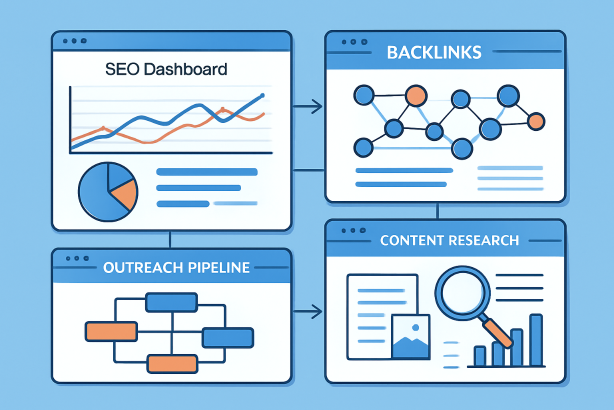

Link building becomes expensive fast when the process is scattered across browser tabs, spreadsheets, inboxes, and disconnected tools. That is why the right SEO software matters. It does not build links for you, but it gives structure to the work that actually earns them: finding relevant sites, reviewing backlink opportunities, managing outreach, and verifying that hard-won links stay live.
If you are trying to build a repeatable system instead of chasing one-off wins, this tutorial will walk you through how to use SEO software step by step for link building. The goal is simple: create a workflow that helps you find better prospects, contact them with a clear reason, and monitor results without losing control of quality.
This guide is written for marketers, founders, in-house SEO teams, and agencies that want a practical process. Whether you are just building your first campaign or tightening an existing one, the steps below will help you use software as an operating system for link acquisition, not just a reporting layer.
Why SEO software matters in link building
Link building is a sequence of decisions. Which pages deserve links first? Which websites are relevant enough to contact? Which contacts should be prioritized? Which links are still live a month later? Without a system, those decisions become inconsistent. Good SEO software makes the workflow visible, measurable, and easier to improve.
For link building, your software should support four jobs at once: research, qualification, outreach management, and backlink monitoring. If one of those breaks, the campaign usually slows down or fills with low-value activity.
| Stage | What you are trying to do | How SEO software helps |
|---|---|---|
| Research | Find relevant sites and pages worth contacting | Supports link prospecting, competitor backlink analysis, and filtering |
| Qualification | Remove weak, irrelevant, or risky opportunities | Keeps quality signals and notes in one place |
| Outreach | Contact the right person with the right angle | Organizes outreach management, follow-ups, and statuses |
| Monitoring | Confirm links go live and stay valuable | Tracks placement, anchor text, destination URLs, and changes over time |
How to use SEO software for link building: step by step
Step 1: Set a clear link building goal before you touch the software
The biggest mistake in link building is starting with a list of websites instead of a business objective. Before you run a single search, decide which pages need authority and why. In most cases, that means choosing a small set of target URLs such as a core service page, a category page, or a high-value article that supports a commercial topic.
Your goal should define the campaign. If you are building links to a service page, you may need contextual editorial placements on highly relevant websites. If you are supporting a content asset, resource pages, partnerships, or digital PR-style mentions may fit better.
- Choose the exact pages you want to strengthen
- Decide what type of links make sense for those pages
- Set quality standards before outreach begins
- Keep anchor text expectations realistic and natural
When this foundation is clear, your SEO software becomes a tool for execution instead of a source of noise.
Step 2: Define your prospecting filters before you build a list
Strong campaigns are usually won during filtering, not outreach. A smaller list of well-matched prospects will outperform a huge database full of marginal opportunities. Use your software to decide what relevance looks like before you begin collecting contacts.
Start with the obvious filters: topical fit, country or region, language, and the types of pages where links could realistically appear. Then go deeper. Ask whether the site publishes original content, whether it links out editorially, whether the audience overlaps with yours, and whether the site is one you would genuinely want your brand associated with.
- Topical relevance to your niche or adjacent topics
- Editorial quality and publication standards
- Likelihood of linking to pages like yours
- Commercial fit for your offer and target market
- Signals that help you spot spam before outreach
This is where link prospecting becomes strategic. You are not trying to find every site. You are trying to find the right sites.
Step 3: Use competitor backlink analysis to find patterns, not just names
Competitor backlink analysis is one of the fastest ways to identify realistic link opportunities, but it works best when you look for patterns instead of copying domain lists. The question is not just who links to a competitor. The better question is why those links exist.
Review competitor backlinks and look for recurring site types. Are they earning links from industry blogs, software directories, local business pages, resource hubs, associations, podcasts, or guest contribution sites? Which pages attract the links: homepage, studies, guides, tools, category pages, or service pages? Those patterns tell you what your outreach should emphasize.
- Sites that link to more than one competitor
- Content formats that attract links consistently
- Common anchor text themes
- Placement types such as lists, mentions, interviews, or resource links
- Gaps where competitors have links and you do not
Good backlink analysis should make your campaign sharper. Instead of copying what others have done, you can identify the kinds of pages and relationships that already exist in your market.
Step 4: Build a qualified prospect list and clean it aggressively
Once you have sources of opportunities, start building a working list. This is where many teams lose discipline. They gather prospects too quickly, skip manual review, and end up sending outreach to sites that were never a fit. Your software should help you enrich, sort, tag, and remove weak entries before a message goes out.
A useful prospect record usually includes the domain, exact target page, contact name or role, email status, outreach angle, notes on relevance, and current stage. If possible, store why the site made the list. That single note is often what makes outreach persuasive later.
- Remove duplicate domains and duplicate contacts
- Exclude irrelevant pages on otherwise relevant sites
- Tag prospects by campaign, topic, and link type
- Record the specific reason each prospect belongs on the list
Clean data improves response quality. It also protects your team from wasting time on prospects that should never have reached the outreach queue.
Step 5: Score opportunities so your team works in the right order
Not every prospect deserves the same effort. A simple scoring model helps you focus first on the opportunities most likely to produce valuable links. Your scoring does not need to be complicated. In fact, simple usually works better because it is easier to apply consistently.
Score prospects against a few practical factors: topical relevance, editorial quality, fit with your target page, likelihood of response, and likely value if the link goes live. Some teams also track whether the prospect is a relationship-based opportunity, a resource page, a partnership contact, or a publication that accepts contributed content.
- High priority: very relevant, high-quality, strong placement potential
- Medium priority: relevant but less certain or slower to convert
- Low priority: acceptable only if higher-value opportunities are exhausted
This step sounds simple, but it changes performance. When SEO software shows your team what deserves immediate attention, outreach becomes more deliberate and less reactive.
Step 6: Match the outreach angle to the opportunity
Generic outreach underperforms because it ignores context. The same message should not be sent to a niche publisher, a resource page editor, a partner, and a blogger who recently mentioned a related topic. Use your software to map each prospect to the most appropriate outreach angle before contacting them.
Common link building angles include resource page inclusion, guest contributions, unlinked mention requests, broken link replacement, expert commentary, partnerships, and editorial suggestions tied to a genuinely useful asset. The outreach note stored in your system should explain which angle you are using and why it fits the prospect.
- Reference the exact page or article you are contacting them about
- Explain why your page adds value to their audience
- Keep the request clear and easy to assess
- Avoid templates that sound mass-produced
This is also where anchor text analysis becomes useful. If a link does go live, you want the anchor to be natural for the context, relevant to the destination page, and varied across the broader campaign.
Step 7: Run outreach in a controlled workflow
Once the list is qualified and the angle is set, move into execution. Effective outreach management is less about sending more messages and more about keeping every conversation organized. Your software should show exactly where each prospect stands so no one is double-contacted, ignored after replying, or forgotten after a positive response.
A simple outreach workflow often includes these stages: ready to contact, first email sent, follow-up sent, replied, negotiating details, link live, declined, and no response. This level of visibility matters because link building often stretches across days or weeks.
- Use a consistent status system across the team
- Track follow-up timing without overdoing it
- Store conversation notes inside the record
- Separate interested replies from closed opportunities
When the workflow is visible, you can see bottlenecks quickly. Maybe the problem is list quality. Maybe it is messaging. Maybe replies are coming in but not being handled fast enough.
Step 8: Verify every acquired link and start backlink monitoring immediately
A link is not finished work just because someone says yes. Once it is live, verify the details. Check that the link points to the correct URL, that the page is indexable, that the placement is where you expected, and that the anchor text makes sense. Also review whether the link carries attributes that change how much SEO value it may pass.
Then move the link into ongoing backlink monitoring. Links get edited, redirected, removed, or moved behind pages that are no longer useful. Monitoring helps you protect the value of the work already done.
- Confirm the destination URL is correct
- Review the anchor text and surrounding context
- Note placement type and page quality
- Recheck links periodically for changes or loss
This is where software earns its keep. Without a monitoring system, link reclamation becomes almost impossible to manage at scale.
Step 9: Review campaign data and improve the process monthly
After enough activity has accumulated, step back and review what the campaign is teaching you. Which prospect sources produce the best placements? Which outreach angles get the strongest replies? Which asset types win links most naturally? Where are you losing momentum?
Do not review only outcomes. Review process quality too. You may find that certain tags are too broad, scoring rules need tightening, or follow-up timing needs improvement. The goal is to make the next month more efficient than the last.
- Compare prospect sources by quality and conversion
- Identify weak filters that let poor opportunities through
- Watch for overused anchor patterns
- Track which links were lost and why
At this point, your SEO software is no longer just a set of features. It becomes the record of how your link building program actually operates.
Common mistakes when using SEO software for link building
Even strong tools can produce weak campaigns if the process is sloppy. A few mistakes show up again and again.
- Confusing volume with quality. Bigger lists do not automatically mean better campaigns.
- Skipping manual review. No software filter can replace editorial judgment.
- Using one outreach template for every prospect. Relevance must carry through to the message.
- Ignoring post-placement checks. A link should be verified, logged, and monitored.
- Over-optimizing anchors. Natural variation matters more than forcing keyword-heavy text.
- Failing to learn from past campaigns. If you do not review outcomes, the workflow never improves.
The practical takeaway is simple: software makes a good process faster, but it also makes a bad process easier to scale. Quality control has to stay built in.
What to look for in SEO software for link building
If you are evaluating platforms, look beyond feature checklists and ask how well the software supports your actual workflow. The best setup is the one your team can use consistently from prospecting through reporting.
- Research tools: support for link prospecting, filtering, and competitor backlink analysis
- Qualification workflow: easy tagging, notes, scoring, and list cleaning
- Outreach management: contact records, statuses, follow-up tracking, and collaboration
- Link verification: a clear way to confirm live placements and anchor details
- Backlink monitoring: visibility into lost, changed, or redirected links
- Reporting: simple summaries for clients, stakeholders, or internal teams
Most importantly, choose SEO software that helps you make better decisions, not just collect more data. In link building, clarity beats complexity.
Ready to make your link building workflow easier to manage? If you want one place to organize prospecting, track outreach, monitor live links, and keep reporting clean, Rabbit SEO is worth a closer look. A more connected workflow means less time fighting spreadsheets and more time building links that actually support rankings.
Conclusion: SEO software works best when the process is disciplined
The value of SEO software in link building is not that it magically creates backlinks. Its real value is operational. It helps you define goals, find stronger prospects, run cleaner outreach, and protect the links you earn. When you use it step by step, software turns link building from a messy set of tasks into a repeatable system.
If your current workflow feels fragmented, start with the basics in this guide: set the goal, tighten the filters, study competitor patterns, qualify every prospect, track every conversation, and monitor every live link. Do that consistently, and your software becomes more than a tool. It becomes the foundation of a better link building program.