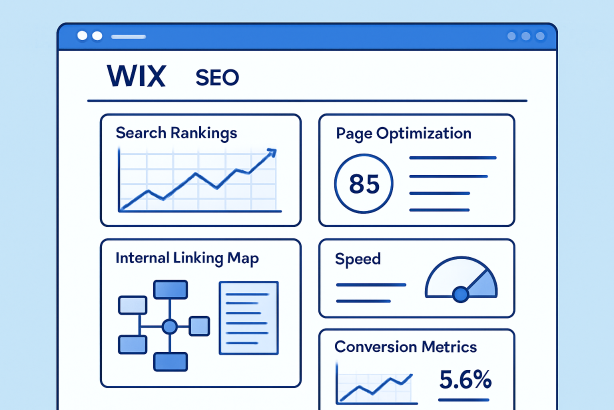

SEO for Wix has matured dramatically, and in 2026 the platform is fully capable of supporting serious organic growth when it is configured correctly. The difference between a Wix site that struggles and one that ranks usually comes down to execution: clear site architecture, disciplined on-page optimization, strong internal linking, and technical cleanliness.
This tutorial covers the best practices that matter most now. Whether you run a local business site, a content-driven brand, or an online store, the goal is the same: make your Wix site easy for search engines to crawl, easy for users to navigate, and easy for high-intent visitors to convert on.
Why SEO for Wix matters more in 2026
Search visibility is more competitive than ever. Publishing more pages alone is not enough. Search engines reward sites that demonstrate relevance, clarity, trust, and usability. Wix gives site owners a strong foundation, but it does not replace strategy.
In practical terms, successful SEO for Wix in 2026 means:
- Planning pages around search intent instead of publishing generic copy
- Using clean page structure so important content can be found quickly
- Optimizing templates and repeated page types to save time and improve consistency
- Fixing technical friction that can weaken crawling, indexing, and performance
- Turning traffic into leads or sales with stronger commercial pages
If your site is already live, the good news is that many gains come from improving what you already have rather than rebuilding from scratch.
Start with site architecture before anything else
The best Wix SEO checklist still starts with information architecture. If your pages are scattered, overlap in topic, or sit too deep in the navigation, rankings will be harder to earn and maintain.
Build topic clusters, not isolated pages
Create one primary page for each high-value topic, then support it with related subpages or blog posts. For example, a service business might build:
- Main service page
- Location pages
- Industry-specific pages
- FAQ content
- Supporting blog posts that answer pre-purchase questions
This structure helps search engines understand topical relationships and gives you more opportunities to add useful internal links.
Keep URLs short and descriptive
Use simple slugs that match the page topic. Avoid unnecessary parameters, vague wording, or dates unless they are genuinely useful. A clean URL is easier to understand, easier to share, and easier to maintain.
Limit navigation bloat
Do not put every page in the main menu. Your top navigation should highlight the most commercially important destinations. Secondary pages can be linked contextually from hubs, footers, and related content sections.
Set up the core Wix SEO settings correctly
Wix gives you direct control over many of the SEO basics. The key is to treat them as part of a system rather than one-off edits.
Title tags and meta descriptions
Every indexable page should have a unique title tag and meta description. Put the primary topic early in the title, keep the wording specific, and write descriptions that improve click-through rate rather than just repeating keywords.
For example, a service page title should state the service and qualifier clearly. A blog post title should reflect the exact problem or outcome the reader expects.
SEO patterns for scale
If your site uses repeated page types such as product pages, category pages, or location pages, set SEO patterns where appropriate. This keeps metadata consistent and reduces the risk of duplicate or missing tags.
Custom page slugs and canonicals
Review slugs before publishing. If you change a slug later, set a proper redirect. Also check canonical settings where duplicate or near-duplicate versions of content could appear, especially on eCommerce or filtered pages.
Image alt text
Alt text should describe the image in context, not stuff keywords. For product, service, and portfolio pages, this can help reinforce page relevance while improving accessibility.
On-page SEO for Wix: what to optimize on every important page
On-page SEO for Wix works best when each page has one clear purpose. That means one primary search intent, one main conversion action, and one strong content hierarchy.
Use headings strategically
Your H1 should identify the page topic clearly. Subheadings should break the page into useful sections that answer real questions. Do not use headings just for styling. Use them to organize meaning.
Match search intent, not just keywords
A page targeting a commercial query should explain the offer, benefits, process, proof, FAQs, and next step. A page targeting an informational query should teach clearly and lead naturally to the next relevant page or offer.
Strengthen internal linking
Internal links remain one of the most overlooked opportunities on Wix sites. Add links from blog posts to service pages, from service pages to case-relevant supporting content, and between closely related pages. Use descriptive anchor text, but keep it natural.
Write for conversions as well as rankings
Traffic alone is not the goal. Strong pages include clear calls to action, benefit-led copy, trust elements, concise forms, and friction-free next steps. Better conversion signals support business performance even when traffic levels stay flat.
Wix technical SEO best practices for 2026
Wix technical SEO has improved, but site owners still need to monitor the basics carefully.
Indexation control
Not every page should be indexed. Thank-you pages, internal utility pages, thin tag-like pages, and duplicate filtered variations often do not belong in search. Keep your indexed set focused on pages that can genuinely rank and convert.
Redirect management
Whenever a page is removed or its URL changes, set a redirect immediately. Redirect chains should be minimized, and broken links should be fixed at the source wherever possible.
Structured data
Add structured data where it is relevant and accurate. Common examples include organization, local business, product, article, breadcrumb, and FAQ markup. Structured data does not guarantee rich results, but it helps search engines interpret page meaning more confidently.
Wix site speed and media hygiene
Wix site speed is influenced heavily by page design choices. Use properly sized images, avoid oversized video backgrounds on critical pages, reduce unnecessary animations, and keep above-the-fold sections focused. A visually impressive page is not effective if it loads slowly or shifts during rendering.
Mobile-first UX
Review every key page on mobile, not just desktop. Check button spacing, sticky elements, form usability, menu behavior, and how quickly users can access the main value proposition. In many niches, mobile is the primary experience.
Content strategy that supports SEO for Wix long term
If you want sustainable growth, publish with a map. Random blogging rarely compounds.
Prioritize bottom-of-funnel topics
Start with content that supports revenue pages. Examples include comparisons, pricing explainers, service selection guides, implementation FAQs, and buyer-oriented how-to content. This kind of content often attracts visitors closer to action.
Refresh existing pages before creating new ones
Many Wix sites have underperforming pages that are already close to useful. Improve them by tightening the search intent, expanding thin sections, updating internal links, refining titles, and improving CTAs.
Use editorial standards consistently
Every new article should have a target keyword, a primary intent, a linking plan, and a conversion path. This discipline improves quality control and makes content production more scalable.
Local SEO for Wix and eCommerce SEO for Wix
Different business models need different priorities.
Local SEO for Wix
If you serve specific areas, create strong local landing pages only where you have genuine relevance. Include localized service details, supporting FAQs, trust signals, and consistent business information. Connect your pages logically to contact and conversion points.
eCommerce SEO for Wix
For stores, category pages often matter as much as product pages. Optimize collection titles, descriptions, filtering logic, internal links, and related product paths. Avoid thin product copy from manufacturers, and make sure discontinued products are handled cleanly with redirects or helpful alternatives.
Common Wix SEO mistakes to avoid
- Publishing duplicate service pages that target nearly identical keywords without a unique angle
- Ignoring internal links after new content goes live
- Over-designing pages at the expense of speed and clarity
- Leaving default metadata in place on templates or products
- Creating location pages with no local substance
- Letting outdated URLs break during redesigns or restructuring
A practical 2026 Wix SEO checklist
| Area | Best practice | Why it matters |
|---|---|---|
| Site structure | Group pages by topic and intent | Improves crawl paths and topical clarity |
| Metadata | Write unique titles and descriptions | Supports relevance and click-through rate |
| On-page | Use one clear H1 and strong subheadings | Makes pages easier to read and interpret |
| Internal links | Link supporting content to money pages | Strengthens authority flow and conversions |
| Technical SEO | Manage canonicals, redirects, and indexation | Prevents duplication and crawling waste |
| Performance | Compress media and simplify heavy layouts | Improves user experience and page efficiency |
| Local or eCommerce | Optimize the page types that drive revenue | Focuses effort where ROI is highest |
Turn your Wix SEO work into measurable growth
The strongest SEO plans are the ones you can actually execute consistently. If you want a faster way to uncover optimization opportunities, organize target keywords, and keep your Wix SEO workflow focused on actions that matter, Rabbit SEO can help. Use it to spot gaps, prioritize improvements, and turn your content and technical efforts into a cleaner ranking strategy.
If you are serious about scaling SEO for Wix in 2026, explore Rabbit SEO and build a more systematic optimization process.
Final thoughts on SEO for Wix
SEO for Wix is no longer about whether the platform can rank. It can. The real question is whether your site is structured, optimized, and maintained well enough to compete. In 2026, the winning approach is straightforward: build around search intent, tighten technical foundations, publish pages that deserve to rank, and connect everything with smart internal linking. Do that consistently, and SEO for Wix becomes a growth channel rather than a guessing game.