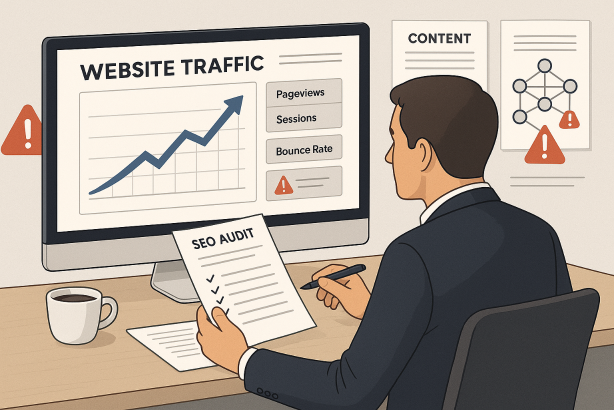

When teams ask how to get more website visitors, they usually expect a list of growth tactics: publish more content, target more keywords, build more links, post more often. In practice, traffic growth usually stalls for a simpler reason. The foundation is leaking.
Across site reviews, recovery projects, and content overhauls, the same patterns appear again and again. Pages are created without clear search intent. Site structure is too shallow or too messy. Technical issues keep good content from performing. Internal linking is an afterthought. Measurement focuses on activity instead of outcomes.
This is why a case-study mindset matters. Instead of chasing isolated tips, it helps to examine the failure patterns that repeatedly hold websites back. If you want a durable answer to how to get more website visitors, start by removing the mistakes that make every tactic less effective.
How to get more website visitors: the mistake patterns that keep showing up
Most traffic problems are not caused by one dramatic error. They come from a stack of smaller decisions that weaken discoverability, relevance, and usability. A site might have decent content but poor internal links. Good topic coverage but weak page targeting. Strong product pages but blog content that never connects to commercial intent.
That is why traffic plateaus can feel confusing. The site is active, but not strategic. The following six mistakes are the ones most likely to slow website traffic growth even when a team is working hard.
Mistake 1: Chasing keyword volume instead of search intent
One of the most common SEO mistakes is choosing topics because the numbers look attractive, not because the query matches what the site can genuinely serve. High-volume keywords create false confidence. They look like traffic opportunities, but if the page does not match what searchers want, rankings are unstable and engagement suffers.
Good keyword research is not just about terms. It is about intent. Is the searcher learning, comparing, troubleshooting, or buying? If your page tries to rank for a commercial phrase with an informational article, or for an educational phrase with a product-first landing page, it will fight uphill.
- Review the current top-ranking pages before creating content.
- Identify whether the query is informational, navigational, commercial, or transactional.
- Build the page format around that intent instead of forcing every keyword into the same template.
When sites align topic selection with search intent, traffic quality usually improves before traffic volume does. That is the right order.
Mistake 2: Publishing content without a traffic architecture
Many sites publish articles one by one with no clear relationship between them. The result is content sprawl: multiple thin posts on overlapping topics, orphaned pages, and no obvious pathway from discovery to conversion. This weakens topical authority and confuses both users and search engines.
A stronger content strategy treats growth like a structured system. Core pages target broad, high-value themes. Supporting pages answer specific questions, cover subtopics, and link back to the core page. Commercial pages are integrated into that structure rather than separated from it.
In case-study terms, this is often the turning point between busy publishing and actual momentum. A site with 30 disconnected articles can underperform a site with 10 tightly connected pages.
What to do instead
- Group topics into clusters based on one clear parent theme.
- Create one authoritative page for each primary topic.
- Map supporting content to that page with purposeful internal links.
- Retire, merge, or redirect overlapping posts where necessary.
If you want to learn how to get more website visitors, stop thinking only in terms of new pages. Think in terms of a stronger site architecture.
Mistake 3: Ignoring technical friction that limits organic traffic
Not every traffic issue is a content issue. Sometimes the site is simply hard to crawl, slow to load, or confusing to render. Even excellent pages lose visibility when technical barriers make indexing or user experience worse than it should be.
Common technical SEO problems include duplicate versions of pages, broken internal links, weak mobile performance, bloated templates, indexation confusion, and unnecessary redirect chains. None of these are glamorous, but they create friction at exactly the wrong moment.
Teams often postpone technical cleanup because it feels less urgent than publishing. But if search engines struggle to access or interpret important pages, new content enters a poor environment.
- Check whether important pages are crawlable and indexable.
- Improve template speed and reduce unnecessary script weight.
- Fix broken links and redirect loops.
- Make sure canonical signals and page hierarchy are consistent.
Technical improvements rarely replace strategy, but they often unlock the performance of work you have already done.
Mistake 4: Treating on-page SEO like a checklist instead of a communication tool
Basic on-page SEO still matters, but not as a box-ticking exercise. Titles, headings, introductory copy, image context, and internal anchors should help clarify the page’s purpose. Too often, pages either under-optimize and stay vague or over-optimize and become awkward.
The strongest pages make relevance obvious. The primary topic appears naturally in the title, intro, heading structure, and conclusion. Related terms reinforce context. The copy is easy to scan. Important questions are answered early. Supporting detail is easy to find.
Just as important, internal links should not be random. They should guide users from high-level questions to deeper pages and from informational content to commercial pages when appropriate.
Watch for these signals
- Generic title tags that fail to differentiate the page.
- Headings that sound clever but hide the real topic.
- Paragraphs that delay the answer.
- Internal links that exist, but do not support the user journey.
Clear pages tend to earn better engagement because they feel useful immediately.
Mistake 5: Making every page sell too hard
Sites that want more traffic often sabotage themselves by pushing conversion too early. A visitor who searches for a problem, definition, comparison, or process usually needs clarity before a sales message. If every page feels like a pitch, the content loses trust and relevance.
This mistake is especially common on blogs that are meant to support acquisition. Educational pages should still support revenue, but indirectly at first. Their job is to match the query, build confidence, and create the next step.
A better model is simple: informational pages educate, comparison pages frame choices, and commercial pages convert. They should work together, not compete with one another.
- Keep intros focused on the reader’s problem.
- Add calls to action that fit the stage of intent.
- Use product mentions where they genuinely help, not everywhere.
Traffic quality improves when content respects the reason the visitor arrived.
Mistake 6: Measuring output instead of progress
Another hidden blocker to organic traffic growth is bad measurement. Many teams track what is easy to count: posts published, keywords added, pages updated. Those metrics are useful for operations, but they do not tell you whether the site is getting stronger.
A case-study approach looks instead at signals that reflect progress:
- Are priority pages being indexed and crawled consistently?
- Are target pages earning more impressions for relevant queries?
- Are visitors moving from informational pages to commercial ones?
- Are content clusters strengthening visibility around core topics?
When measurement focuses on these questions, teams make better decisions. They stop rewarding activity and start rewarding traction.
A practical case-study checklist for how to get more website visitors
If your traffic has flattened or never reached expectations, start with a structured review. In most real-world audits, the fastest gains come from fixing alignment before expanding output.
| Problem pattern | What it usually causes | First fix |
|---|---|---|
| Wrong keyword targeting | Low relevance and weak rankings | Rebuild pages around true search intent |
| Disconnected content | Thin authority and poor navigation | Create topic clusters and stronger internal links |
| Technical friction | Weak crawlability and inconsistent performance | Fix indexation, speed, and link issues |
| Weak on-page signals | Unclear relevance | Improve titles, headings, intros, and anchors |
| Overly aggressive selling | Lower trust and weaker engagement | Match calls to action to the page intent |
| Poor measurement | Misleading priorities | Track page-level visibility and user paths |
This sequence matters because it prevents you from scaling the wrong system. More content does not fix misalignment. Better architecture, clearer intent targeting, and cleaner execution do.
Before you publish more, tighten the system
If you are serious about how to get more website visitors, resist the urge to solve every traffic problem with volume. Audit what already exists. Strengthen the pages that should matter most. Connect your content to a real journey from search to action.
If you want a faster way to spot missed opportunities, Rabbit SEO can help you review rankings, page targeting, internal linking opportunities, and site-level issues before they become growth bottlenecks. That kind of visibility makes it easier to invest in the pages with the highest upside.
Conclusion: how to get more website visitors without repeating the same mistakes
The best answer to how to get more website visitors is rarely publish more and hope. Sustainable traffic growth comes from avoiding the mistakes that dilute relevance, authority, usability, and trust. Choose topics based on intent. Build a clear content structure. Remove technical friction. Strengthen on-page signals. Respect the visitor’s stage. Measure what moves performance.
Do that consistently, and traffic growth becomes less mysterious. It becomes the natural outcome of a better system.