
Google AI Overviews SEO is quickly becoming a practical budget question, not just a tactical one. For many teams, the issue is no longer whether this search feature matters. The real question is which pages, workflows, and investments are most likely to earn visibility when Google summarizes answers directly in the results.
That is where a commercial comparison helps. Instead of treating every page the same, smart teams compare what performs better across query types, content formats, and execution models. In this case-study style analysis, we will look at the choices that typically separate pages that are easy for Google to reference from pages that remain invisible, even when they rank reasonably well in traditional results.
The short version is simple: Google AI Overviews SEO rewards clarity, corroboration, intent match, and strong topical coverage. It does not reward vague thought leadership, thin content expansion, or isolated articles with weak supporting context. If your current strategy depends on publishing more pages without tightening structure and relevance, you may be spending in the wrong places.
Why Google AI Overviews SEO needs its own playbook
Traditional SEO still matters. Rankings, crawlability, internal links, authority, and page quality remain foundational. But overview-style search results change the competitive environment in a few important ways.
- The best answer can be passage-level, not page-level. A page may be useful overall, but only a few sections are structured clearly enough to be surfaced.
- Intent alignment matters more than word count. A concise, direct answer often beats a longer article that takes too long to reach the point.
- Corroboration across your site becomes more valuable. When multiple pages support the same topic consistently, your content is easier to trust and interpret.
- Search visibility becomes more blended. You are not only competing for blue links. You are competing for presence inside a summary layer above or around classic rankings.
For commercial teams, that means the old model of publishing a blog post, waiting for rankings, and calling it a win is less reliable. You need content that can be parsed, matched to intent, and supported by the rest of your site.
Google AI Overviews SEO vs traditional organic SEO
The overlap between the two is real, but the emphasis is different. The table below shows where the shift usually happens.
| Dimension | Traditional organic SEO | Google AI Overviews SEO | Commercial takeaway |
|---|---|---|---|
| Primary goal | Rank pages as high as possible | Become a reliable source for answer extraction and synthesis | Optimize for rankings and answer inclusion together |
| Winning asset | Strong page-level relevance | Strong page-level relevance plus clear answer blocks | Improve layout, not just keyword targeting |
| Best query type | Broad mix of informational, navigational, and transactional queries | Mainly informational and comparison-driven queries | Prioritize overview-prone topics first |
| Content structure | Can tolerate longer intros and looser hierarchy | Rewards concise sections, explicit subheadings, and fast answers | Editorial structure becomes a performance factor |
| Authority signals | Backlinks and domain strength remain central | Backlinks matter, but topical depth and consistency become easier to notice | Topic clusters often outperform isolated articles |
| Measurement | Rankings, traffic, conversions | Blended visibility, branded lift, assisted conversions, page engagement | Use a wider reporting lens |
This is why featured snippets vs AI Overviews is the wrong debate for many businesses. They are related opportunities, but not identical ones. A snippet strategy alone is too narrow. A broader AI Overviews optimization strategy requires stronger internal topic coverage and a clearer editorial architecture.
Case-study comparison: which page types are more likely to win
Instead of leaning on a single anecdote, it is more useful to compare common page types that businesses already publish. These side-by-side cases show where the advantage tends to shift.
Case 1: Publisher-style blog post vs product-led explainer page
A publisher-style blog post often targets a broad informational phrase with educational copy, examples, and a soft CTA. A product-led explainer page answers the same query, but ties the answer to a workflow, problem, or category the business directly serves.
When the publisher-style post wins:
- The query is early-stage and purely educational.
- The article answers the question immediately and covers common follow-up questions.
- The page is supported by related content that reinforces topical authority.
When the product-led explainer page wins:
- The query has clear commercial intent, even if phrased informatively.
- The page defines the topic cleanly, explains tradeoffs, and connects the topic to decision-making.
- The product context adds clarity rather than promotional noise.
Commercial lesson: if your business only publishes blog content for overview-prone queries, you may miss high-value visibility. Many of the best opportunities sit between pure education and pure conversion. Product-led explainers can outperform generic blog posts when they answer the query directly and transparently.
Case 2: One long guide vs a structured topic cluster
Many teams still prefer a single skyscraper page for a topic. That approach can rank, but it is not always the cleanest format for how to rank in Google AI Overviews.
A structured cluster usually includes:
- A main hub page that defines the topic and addresses broad intent.
- Supporting pages that answer narrower sub-questions.
- Clear internal links that map relationships between concepts.
Why the cluster often has the commercial edge:
- It creates clearer semantic boundaries between subtopics.
- It gives Google multiple corroborating sources on your own domain.
- It improves internal linking naturally.
- It reduces the risk that a single page tries to answer everything poorly.
Commercial lesson: if you are deciding between commissioning one flagship article or building a small cluster around a money topic, the cluster is usually the better long-term asset. It supports both semantic SEO strategy and conversion journeys.
Case 3: Opinion page vs evidence-backed resource page
Some brands publish commentary-heavy pages that state strong viewpoints but offer limited explanatory structure. Others publish resource pages that define terms, explain methods, compare options, and clarify when each option fits.
For overview visibility, the second format is generally more durable because it is easier to extract, summarize, and align with intent. This does not mean your brand voice should disappear. It means opinion should sit on top of a strong factual framework, not replace it.
Commercial lesson: pages built only to express a stance rarely compete as well as pages built to resolve a searcher question. If the query invites a decision, your page should help someone make that decision quickly.
Commercial comparison: in-house execution, agency support, or platform-led workflow
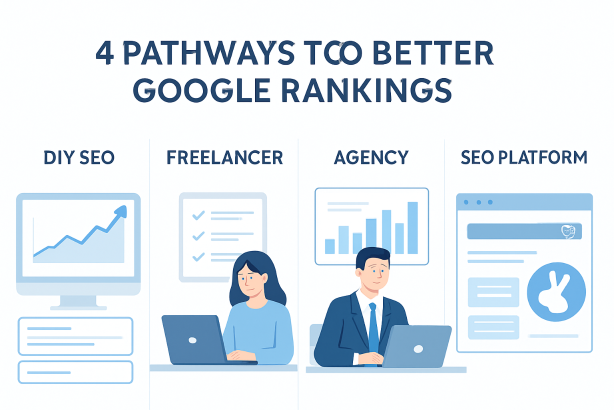
Once the strategy is clear, the next question is operational. Businesses usually approach Google AI Overviews SEO in one of three ways.
| Model | Best for | Strengths | Limits |
|---|---|---|---|
| In-house only | Teams with strong editorial, SEO, and dev capacity | Deep product knowledge, direct control, fast internal alignment | Can stall if keyword prioritization, page structure, and reporting are inconsistent |
| Agency-led | Brands that need strategy and production support | Outside perspective, scalable execution, specialist experience | Can become expensive if the workflow depends on high monthly content volume |
| General SEO suite | Teams focused on broad ranking management | Useful for tracking, audits, and keyword monitoring | May not create a clear workflow for overview-specific content prioritization |
| Platform-led workflow with Rabbit SEO | Teams that want faster prioritization and execution clarity | Helps turn search opportunities into a more practical action plan | Still requires strong content decisions and consistent publishing discipline |
The most important buying principle is not tool count. It is workflow fit. If your team already knows what to publish and in what order, a broad suite may be enough. If your challenge is deciding which queries deserve investment, which pages should be rebuilt, and where internal support is weak, a more focused workflow is usually the better commercial choice.
What strong Google AI Overviews SEO pages tend to have in common
If you compare pages that are easier to surface in overview-style results, a few repeated patterns stand out.
- A direct answer near the top. Do not bury the main explanation beneath a long intro.
- Clean heading hierarchy. Each section should answer a specific related question or subtopic.
- Clear entities and definitions. This is where entity SEO becomes practical rather than theoretical.
- Support from adjacent pages. Strong overview pages are rarely isolated from the rest of the site.
- Useful comparisons. Comparison tables, use cases, pros and cons, and decision frameworks often help because they map closely to real search behavior.
- Moderate, not bloated, depth. Depth matters, but padding does not.
This is also where topical authority SEO becomes commercially meaningful. Authority is not just about being known for a topic. It is about making your site easy to trust across an entire subject area.
A practical optimization checklist
If you want to improve visibility without rebuilding your whole content library at once, start here.
- Identify overview-prone queries. Focus first on informational, comparative, and decision-support searches rather than purely transactional terms.
- Rewrite intros for directness. Lead with an answer, definition, or decision summary.
- Add answer-first subsections. Use clear h2 and h3 structures that mirror real search questions.
- Consolidate overlap. If five weak articles compete for the same intent, merge them into a stronger asset and redirect appropriately.
- Strengthen internal links. Connect the main page to definitions, examples, category pages, and adjacent use cases.
- Use valid structured data where appropriate. Match schema to the true page type, but do not expect markup alone to create visibility.
- Review commercial fit. Make sure the page can guide the reader to the next logical action once the question is answered.
This approach is especially useful if you are balancing zero-click search SEO concerns. Even when some clicks disappear, stronger overview visibility can still improve brand discovery, assisted conversions, and category-level presence.
When Google AI Overviews SEO should not be your first priority
Not every business should move this to the top of the roadmap immediately.
- If your site still has major crawl, indexation, or duplication problems, solve those first.
- If your revenue depends mainly on bottom-funnel transactional queries, keep commercial pages and conversion paths at the center.
- If your content lacks subject depth, building a few stronger topic clusters may matter more than chasing broad overview visibility right away.
In other words, Google AI Overviews SEO is not a replacement for core SEO. It is a higher-leverage layer once the basics are under control.
Make the commercial decision, not just the editorial one
The brands that benefit most from overview visibility are usually the ones that treat it as a prioritization problem. They compare page types, intent classes, and workflows before they increase output. They invest in pages that are easy to summarize, easy to trust, and closely tied to business value.
If your team wants a simpler way to turn those priorities into an execution plan, Rabbit SEO is worth a look. Explore Rabbit SEO to organize your search opportunities, focus on the pages that deserve action first, and build a workflow that supports both rankings and overview visibility.
Conclusion
Google AI Overviews SEO is best approached as a commercial comparison, not a publishing race. The pages most likely to win are usually not the longest or loudest. They are the clearest, best-structured, best-supported answers on topics that matter to the business. If you compare your current content through that lens, the next set of priorities becomes much easier to see.