
SEO for ecommerce is entering a more technical phase. The old playbook of publishing more pages, adding a little copy, and hoping product URLs rank on volume alone is no longer enough for serious growth. Large catalogs create duplication, thin pages, JavaScript rendering issues, variant complexity, and thousands of low-value URLs that can dilute visibility if they are left unmanaged.
The hot trend in SEO for ecommerce is not a gimmick. It is technical clarity at scale: building stores that search engines can crawl efficiently, understand precisely, and index selectively. That means cleaner architecture, stronger internal linking, better handling of filters and variants, richer structured data, and category templates designed for both users and crawlers.
For ecommerce brands, this shift is commercially important. When technical foundations improve, category pages become easier to discover, product pages become easier to interpret, and seasonal or high-margin collections become easier to surface. In practical terms, strong technical SEO for ecommerce helps search engines spend time on the pages that matter most to revenue.
The hot trend in SEO for ecommerce is technical clarity at scale
Search engines have become better at evaluating entire sites, not just individual pages. That raises the standard for ecommerce. A store with 500 products and a store with 500,000 products face the same core question: can search engines quickly understand what is important, what is unique, and what deserves to rank?
That is why the current trend is moving away from brute-force indexation and toward controlled discoverability. The strongest ecommerce sites do not try to index every URL the platform can generate. They intentionally shape crawl paths, index only commercially meaningful page types, and expose product information in a structured, stable format.
| Old priority | Current priority | Why it matters |
|---|---|---|
| More pages | Better page selection | Index quality improves when low-value URLs are reduced. |
| Untamed filters | Controlled faceted navigation | Prevents crawl waste and duplication. |
| Product-page obsession | Category and collection strength | Category pages often match broader commercial intent. |
| Client-side dependency | Reliable HTML output | Critical content must be accessible without rendering delays. |
| Loose internal links | Intentional link systems | Important templates gain authority and discovery paths. |
If you are refining a growth roadmap, these are the technical trends worth prioritizing now.
1. Crawl-efficient architecture is becoming a competitive advantage in SEO for ecommerce
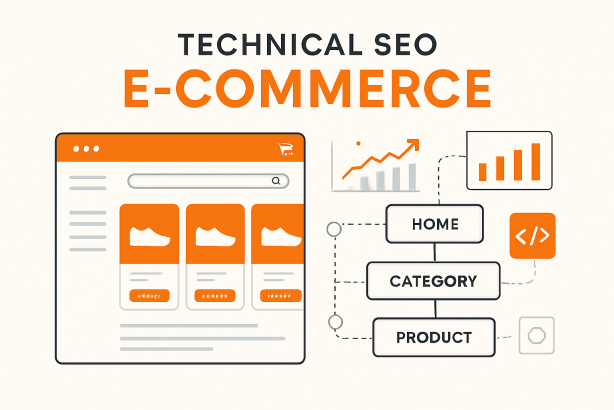
Good ecommerce site architecture is simple to describe and easy to crawl. Search engines should be able to move from the homepage to top-level categories, then into subcategories, then into products, without getting trapped in loops, parameters, or thin internal search pages.
The practical goal is a predictable hierarchy. Every product should belong to a logical path, and every important category should be reachable through crawlable internal links rather than depending on scripts, overlays, or site search. When architecture is consistent, search engines understand topical relationships across your catalog more clearly.
Build a hierarchy that matches buyer intent
- Top-level categories should reflect broad commercial demand.
- Subcategories should separate product types, use cases, or major attributes.
- Product pages should sit within the most relevant category path.
- Support hubs such as buying guides, care guides, and comparison pages should connect into the shopping journey rather than live in isolation.
This structure helps category page SEO because it reinforces which pages represent the main commercial themes of the store. It also reduces orphaned products and thin collections that sit too far away from the core navigation.
Control low-value URLs before they consume crawl demand
Many ecommerce platforms create URLs for sort orders, tracking parameters, internal search results, session states, pagination variations, and filter combinations that have little standalone value. Left unchecked, these URLs can absorb crawl budget and obscure the pages you actually want indexed.
- Keep non-essential parameter URLs out of prominent internal linking paths.
- Use canonical tags to consolidate near-duplicate versions to the strongest URL.
- Reserve indexation for pages with distinct search intent and unique value.
- Prevent endless crawl spaces from search-result pages or uncontrolled filters.
Crawl budget is not just an enterprise concern. Even mid-sized stores can dilute discovery when too many weak URLs compete for attention.
2. Faceted navigation SEO now requires page-level intent decisions
Faceted navigation SEO is one of the biggest dividing lines between healthy and inefficient ecommerce sites. Filters are useful for shoppers, but they can generate an enormous number of combinations with overlapping content. The technical trend now is deliberate indexation, not blanket exposure.
A strong faceted navigation strategy starts with intent. Which filtered states genuinely deserve to exist as landing pages? A category filtered by a widely searched attribute may deserve an indexable URL. A random combination of color, price range, size, stock status, and sort order usually does not.
Choose indexable facets selectively
Indexable filter pages should meet a high standard:
- They align with real search demand.
- They represent a stable product set.
- They can support unique metadata and meaningful page context.
- They are linked intentionally from relevant categories or hubs.
Everything else should be treated as a user-experience feature, not an SEO asset. That means controlling how filters generate URLs, how those URLs are linked internally, and how duplicates are consolidated.
Avoid mixed technical signals
Many stores create confusion by combining canonicals, indexable filter pages, blocked parameters, and weak internal links without a clear system. A cleaner model is to define three groups:
- Primary indexable pages: core categories, subcategories, and selected facet pages.
- Accessible but non-priority pages: useful for shoppers but not meant to rank independently.
- Excluded crawl traps: internal search results, endless parameter combinations, or duplicate sort states.
Once those groups are clear, the rest of the technical setup becomes much easier to manage.
3. Product schema is evolving from markup to merchandising infrastructure
Structured data is no longer a cosmetic enhancement. In SEO for ecommerce, product schema plays a technical role in communicating essential details about products, offers, availability, breadcrumbs, and list relationships in a standardized format.
The key trend is completeness and accuracy. Search engines do not benefit from bloated or misleading markup. They benefit from clean schema that reflects what is visibly present on the page and stays synchronized with product data.
Structured data elements that deserve attention
- Product for core product details.
- Offer for price, currency, availability, and condition where applicable.
- BreadcrumbList to clarify page position within the site hierarchy.
- ItemList on category pages when it helps describe listed products.
- AggregateRating only when genuine review data is available on the page.
For variant-heavy catalogs, schema should reflect the actual page model. If one parent product page controls multiple variants, the markup should not suggest that every child variation is a separate indexable entity unless that is truly how the site is structured. Technical consistency here matters just as much as completeness.
Keep schema aligned with the rendered page
Price, stock status, brand, SKU, and breadcrumb paths often change. If structured data drifts out of sync with visible content, reliability suffers. Treat schema as part of the product data pipeline, not a one-time implementation.
4. Internal linking for ecommerce is becoming a discovery engine
Internal linking for ecommerce has moved far beyond navigation menus and breadcrumb trails. Today, it is a core technical system for signaling importance, surfacing seasonal collections, supporting category page SEO, and passing discovery paths into deeper catalog layers.
Large stores commonly underuse internal links in templates. They rely on global navigation and expect search engines to figure out the rest. A stronger approach uses multiple link pathways:
- Category to subcategory links in body content and merchandising modules.
- Subcategory to adjacent collections where intent overlaps.
- Product to compatible accessories, replacements, or alternatives.
- Editorial guides to commercial categories and selected products.
- Seasonal hubs to evergreen categories that remain relevant after peak periods.
This does two things. First, it improves crawlability and reduces isolation. Second, it helps distribute authority toward the templates that convert best. For many stores, category pages and curated collections deserve far more internal support than they currently receive.
Audit for orphaned and underlinked URLs
If a high-margin collection or strategic category only appears in XML sitemaps, it is underlinked. Important pages should be discoverable through normal site navigation, contextual modules, and crawlable HTML links. Sitemaps are helpful, but they should reinforce discovery, not replace it.
5. JavaScript restraint and Core Web Vitals for ecommerce still matter
Modern storefronts often depend on rich interactive experiences, but heavy front-end execution can still obstruct SEO for ecommerce when critical content is delayed, hidden, or unstable. The trend is not to eliminate interactivity. It is to protect essential SEO signals from being dependent on it.
Render the essentials early
Search engines should be able to access the primary page content in the initial HTML or through highly reliable rendering patterns. That includes:
- Page titles and meta descriptions
- Main headings and category copy
- Product names, prices, and availability
- Breadcrumbs
- Crawlable links to products and subcategories
If these elements only appear after complex scripts execute, visibility becomes less predictable. Technical SEO for ecommerce works best when the page is understandable before advanced enhancements load.
Performance is part of discoverability
Core Web Vitals for ecommerce remain commercially relevant because poor performance affects both user experience and page stability. Product detail pages should avoid layout shifts from late-loading images, sticky banners, or injected review widgets. Category pages should not depend on endless scripts to reveal basic product links. Infinite scroll can work for users, but it should be backed by crawlable paginated URLs if you want reliable discovery.
6. Category page SEO is becoming the center of non-brand ecommerce growth
One of the strongest trends in SEO for ecommerce is the rising strategic importance of category and collection pages. Product pages remain essential, but broad and mid-funnel commercial queries often map more naturally to category templates than to individual products.
That means technical SEO should support category pages as first-class assets. They need unique metadata, strong internal links, indexable template structures, descriptive headings, and room for curated content that helps define the page without overwhelming the shopping experience.
Build category templates that can scale
- Allow custom title tags and meta descriptions at the category level.
- Support editable introductory copy and bottom-of-page content blocks.
- Include crawlable links to relevant subcategories and adjacent collections.
- Enable clean canonical handling when categories overlap.
- Preserve stable URLs during merchandising updates.
In many stores, category pages are where technical SEO and commercial strategy meet. They can target demand, showcase inventory depth, and direct users into the most profitable parts of the catalog. If the template is weak, the opportunity is constrained before content or links even enter the picture.
7. Variant management is now a major technical decision, not a catalog afterthought
Size, color, material, model, pack count, and regional differences can expand an ecommerce catalog dramatically. The technical question is whether each variation deserves its own indexable URL or whether the parent product should absorb that demand.
There is no universal answer, but there should be a consistent one. Problems arise when a site mixes separate variant URLs, loose canonicals, changing metadata, and conflicting internal links. Search engines then struggle to determine which version is primary.
Use a clear variant model
Most stores should choose one of these approaches:
- Parent-led model: one main product URL ranks, while variants are selected within the page.
- Variant-led model: individual variant URLs are indexable because each one serves distinct search demand or product intent.
If you use a parent-led model, keep the canonical, title, schema, and internal linking centered on the main product URL. If you use a variant-led model, make sure each page offers genuinely distinct value, consistent stock data, and a clear reason to exist independently in search.
Also plan for out-of-stock states. Temporary stock issues usually do not justify removing a valuable URL. It is often better to preserve the page, communicate availability clearly, and offer alternatives or restock options than to create churn in indexation.
An implementation checklist for SEO for ecommerce
The fastest way to improve technical SEO for ecommerce is to prioritize systems, not isolated fixes. Use this checklist to focus on the changes that influence discovery, index quality, and commercial landing pages most directly.
| Area | Priority | What to verify |
|---|---|---|
| Site architecture | High | Clear hierarchy from homepage to category, subcategory, and product pages. |
| Faceted navigation | High | Only valuable filtered states are indexable; low-value combinations are controlled. |
| Canonical strategy | High | Near-duplicate URLs consolidate cleanly to the preferred version. |
| Internal linking | High | Important categories, collections, and products are linked contextually and not orphaned. |
| Category templates | High | Metadata, content blocks, and crawlable product links are template-supported. |
| Structured data | Medium | Product schema, offers, and breadcrumbs match visible page content. |
| JavaScript and performance | Medium | Critical content and links are accessible without heavy rendering dependency. |
| Variant management | Medium | Indexation, canonicals, and internal links follow one clear model. |
Turn technical SEO improvements into ecommerce growth
Technical fixes are most valuable when they are tied to business priorities. Start with the pages that drive margin, repeat demand, or strategic category growth. Then align crawl efficiency, internal linking, and schema around those targets. That is how SEO for ecommerce becomes a revenue channel rather than a maintenance project.
If you want a faster way to identify indexation waste, underlinked category pages, duplication risks, and schema gaps across a growing catalog, explore Rabbit SEO. A focused technical workflow helps teams prioritize the changes that improve product discovery and commercial visibility without getting lost in low-impact noise.
Final thoughts on SEO for ecommerce
The hot trend in SEO for ecommerce is not about chasing more URLs. It is about building cleaner systems: better ecommerce site architecture, tighter faceted navigation SEO, stronger product schema, smarter internal linking for ecommerce, and category templates that deserve to rank.
Brands that win the next phase of technical SEO will be the ones that make their stores easier to crawl, easier to interpret, and easier to trust at scale. When the foundation is right, every other optimization works harder. That is why technical clarity has become the most important trend in SEO for ecommerce today.