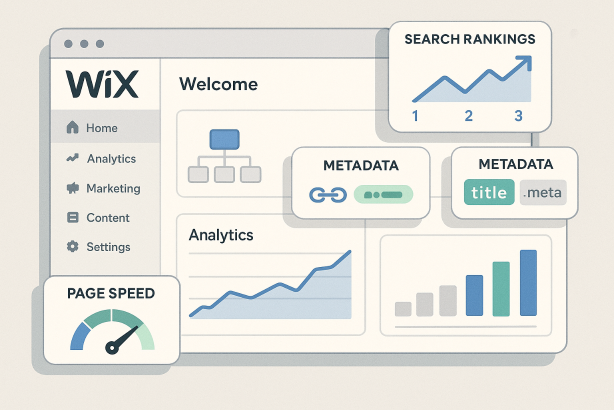

SEO for Wix in 2026 is no longer a debate about whether the platform can rank. It can. The better question is whether your Wix site is built to earn visibility consistently, page by page, query by query, and market by market.
That distinction matters. Plenty of Wix websites look polished, load into a sleek visual experience, and still struggle to generate organic traffic. In most cases, the problem is not the platform itself. It is weak information architecture, shallow content, poor internal linking, unhelpful templates, or technical settings left on autopilot.
This article takes a case-study approach without leaning on inflated claims or made-up numbers. Instead, it focuses on the patterns that repeatedly show up across strong Wix SEO projects: clear site structure, disciplined page targeting, clean technical foundations, and content that matches search intent. If you want a practical playbook for SEO for Wix in 2026, this is where to start.
SEO for Wix in 2026: what has actually changed
The conversation around Wix SEO has matured. A few years ago, many site owners were still asking basic platform questions. In 2026, the serious opportunities are more strategic:
- How do you structure a Wix site for scale?
- How do you prevent index bloat while still publishing useful content?
- How do you create service, category, and location pages that deserve to rank?
- How do you improve conversion paths without hurting crawlability or topical clarity?
Those are the questions that separate average websites from high-performing ones. The strongest Wix sites are not simply better designed. They are better planned. Their navigation makes sense. Their pages have unique jobs. Their metadata is intentional. Their internal links help search engines understand priority and context.
In other words, SEO for Wix in 2026 is an execution game.
Case-study lessons from high-performing Wix sites
When we look at successful Wix websites across service businesses, local brands, and ecommerce stores, the same lessons tend to repeat. These are less about hacks and more about fundamentals done unusually well.
- They target one clear primary intent per page. A page is either a service page, a location page, a category page, a product page, or a supporting article. It is not trying to do all five.
- They avoid thin duplication. Similar pages are differentiated by audience, geography, use case, or product type rather than minor wording changes.
- They build internal authority. Their most important commercial pages are consistently linked from relevant supporting content.
- They keep templates under control. Headers, footers, related content blocks, and app-generated sections support the page instead of drowning it in repetitive elements.
- They treat technical SEO as a maintenance system. Redirects, canonicals, indexing, and page performance are reviewed routinely rather than once at launch.
These are not glamorous insights, but they are the reasons one Wix site compounds organic growth while another stalls.
Build the site architecture before you chase rankings
The best SEO for Wix starts before content production. If your structure is messy, every later optimization becomes harder.
Keep page depth shallow
Important pages should be easy to reach from primary navigation, footer navigation, or contextual internal links. If a money page is buried several clicks deep, it sends weak signals about priority and often receives fewer internal links.
Separate commercial and informational intent
Your service pages should sell the service. Your articles should answer questions. Your category pages should help users browse and compare. Mixing all of this onto the same URL usually weakens the page.
A simple structure for many Wix sites looks like this:
- Core commercial pages: services, categories, collections, key products
- Trust pages: about, process, testimonials, FAQs, policies
- Support content: guides, comparisons, problem-solution articles, location resources
Create scalable URL logic
Before publishing dozens of pages, define how URLs will work. Service areas, blog categories, product types, and collections should follow patterns that make sense to both users and search engines. Clean, readable URLs make ongoing Wix website optimization easier and reduce the risk of duplicate pathways.
Technical SEO for Wix: the best practices that matter most in 2026
Technical SEO for Wix does not need to become overly complex, but it does need to be systematic. The goal is simple: help search engines crawl the right pages, understand the site hierarchy, and avoid wasting attention on low-value URLs.
Review indexation intentionally
Not every page should be indexed. Thank-you pages, internal search results, filtered duplicates, outdated campaigns, and utility pages often do not belong in search. Review what is indexable and why. A smaller, cleaner index is often better than a larger, weaker one.
Use canonicals and redirects with discipline
If pages move, redirect them properly. If multiple URLs can serve near-identical content, make sure canonical signals are aligned with the page you want ranking. This is especially important during redesigns, collection changes, and content consolidation projects.
Watch template-generated duplication
Wix sites often inherit repeated sections across templates. Repetition is not automatically bad, but excessive duplicate headings, boilerplate copy, or auto-generated blurbs can dilute page uniqueness. Audit templates, not just individual pages.
Prioritize real-world performance
Page speed still matters, but in 2026 the more useful lens is experience quality. Heavy media, oversized images, excessive animations, and cluttered third-party add-ons can slow down the experience and weaken engagement. Focus on image compression, restrained design elements, mobile usability, and limiting unnecessary apps or scripts.
Keep mobile UX central
For many Wix sites, mobile is the primary experience. Navigation, tap targets, sticky elements, content order, and page length all influence usability. A site that feels elegant on desktop but frustrating on mobile will struggle to convert search visibility into business results.
| Area | What good looks like | Common Wix mistake | Priority |
|---|---|---|---|
| Indexation | Only valuable pages are indexable | Low-value utility pages left open | High |
| Metadata | Unique titles and descriptions for key pages | Template defaults reused everywhere | High |
| Internal linking | Commercial pages linked from relevant articles and hubs | Orphaned money pages | High |
| Performance | Compressed media and restrained design load | Heavy visuals and too many add-ons | Medium |
| Redirects | Clean migration paths after URL changes | Broken links and lost authority | High |
Wix on-page SEO: where rankings are often won or lost
On-page execution is where many Wix sites underperform. The design is polished, but the page itself gives search engines little clarity about what it should rank for.
Write focused title tags
Your title tag should reflect the page’s primary topic and intent. Put the main keyword close to the front where natural, but do not force it. Strong titles are specific, commercially aware, and differentiated from neighboring pages.
Use headings to reinforce topical structure
Each page should have one clear H1 and a logical H2 and H3 hierarchy. Headings should help the reader scan the page while reinforcing the page’s subject. Avoid vague headings that could fit any page on the site.
Strengthen entity relevance with complete coverage
Pages rank better when they fully address the topic, not when they merely repeat the phrase. A strong service page, for example, may cover who the service is for, process, deliverables, timeline, proof points, FAQs, and next steps. That depth makes the page more useful and more semantically complete.
Improve internal links with intent
Internal links are one of the most overlooked parts of SEO for Wix. Supporting content should point to commercial pages using natural anchor text. Commercial pages should also link laterally where useful, such as related services, collections, or local variations.
Optimize images for search and usability
Use descriptive file names and accurate alt text where appropriate. More importantly, make sure images support the page instead of slowing it down or displacing key copy far below the fold.
Content strategy for SEO for Wix in 2026
Publishing more blog posts is not a strategy. The strongest Wix content programs are built around keyword clusters, intent stages, and conversion pathways.
A practical model looks like this:
- Bottom-of-funnel content: service pages, category pages, comparison pages, pricing or process pages
- Middle-of-funnel content: problem-solution guides, use cases, feature comparisons, implementation advice
- Top-of-funnel content: broader educational topics that introduce the brand to new searchers
The common mistake is over-investing in broad informational posts while neglecting the pages that actually drive revenue. For Wix SEO best practices in 2026, commercial content deserves first-class treatment. That means stronger copy, deeper FAQs, cleaner proof sections, and better internal links into the page.
It also means pruning or consolidating weak articles. If a post has no strategic keyword target, no internal linking role, and no realistic chance of supporting conversions, it may not deserve to stay live.
Local SEO for Wix and ecommerce SEO for Wix
The best practices shift slightly depending on business model, but the principle stays the same: create pages that closely match how people search.
For local businesses
- Build dedicated service pages before building multiple city pages.
- Create location pages only when they can be genuinely differentiated and useful.
- Keep name, address, phone details, service areas, and trust signals consistent.
- Use local FAQs, testimonials, and project context where relevant.
- Connect the site experience to your broader local search presence.
Thin, near-duplicate city pages remain one of the weakest local SEO tactics on Wix and elsewhere.
For ecommerce sites
- Make category and collection pages SEO assets, not just product grids.
- Write unique product copy where commercially important.
- Prevent variant, filter, or sort URLs from creating unnecessary duplication.
- Use internal links from guides, gift lists, and comparisons into category pages.
- Improve product media without overloading page weight.
Ecommerce SEO for Wix often improves fastest when category architecture is cleaned up and supporting editorial content is tied directly to collections.
How to measure whether your SEO for Wix strategy is working
Do not judge progress only by total traffic. Strong measurement ties visibility to business intent.
Track:
- Growth in impressions and clicks for priority queries
- Ranking movement for commercial pages, not just blog posts
- Indexation health and coverage changes
- Internal link distribution to priority URLs
- Organic conversions, leads, or revenue by landing page type
This helps you identify whether your Wix on-page SEO is improving relevance, whether technical changes are helping crawl efficiency, and whether content expansion is actually supporting revenue pages.
The mistakes that still hold Wix sites back
- Publishing too many low-value pages. More URLs do not equal more authority.
- Using one generic template for every page type. Service pages, articles, and collections need different structures.
- Ignoring internal linking. Orphaned pages rarely become stars.
- Chasing broad keywords too early. Most sites grow faster by winning specific, high-intent searches first.
- Letting design overwhelm content. Search engines and users both need substance near the top of the page.
- Failing to review technical settings after launches or edits. Small changes can create indexation, canonical, or redirect problems.
If your rankings are flat, the answer is often found in one of these basics rather than in a missing trick.
A practical 90-day roadmap for SEO for Wix
If you want to turn this into action, keep the first quarter focused.
Days 1 to 30
- Audit indexable pages and remove or refine low-value URLs
- Map the site architecture and identify priority commercial pages
- Fix missing metadata, broken internal links, and redirect issues
- Review templates for duplication and mobile usability problems
Days 31 to 60
- Rewrite core service, collection, or category pages for clearer intent
- Add FAQs, proof sections, and stronger internal links
- Publish supporting content that targets adjacent search intent
- Improve image handling and reduce avoidable page weight
Days 61 to 90
- Expand into cluster content around proven topics
- Consolidate weak posts that do not support the strategy
- Refine navigation and contextual linking based on performance
- Measure commercial page visibility and conversion contribution
This sequence is simple, but it reflects how strong Wix SEO projects usually progress: structure first, core pages second, scale third.
Ready to improve SEO for Wix with a clearer strategy?
If your Wix site looks good but organic growth has plateaued, the issue is usually not a lack of effort. It is a lack of focus. Rabbit SEO can help you identify the structural, technical, and content gaps that are holding performance back, then turn them into a practical roadmap your team can actually execute.
Whether you need a full audit, a page-level optimization plan, or a smarter content architecture, the fastest wins usually come from tightening the fundamentals instead of adding more noise.
Final thoughts on SEO for Wix in 2026
The future of SEO for Wix belongs to sites that are well-structured, technically clean, commercially intentional, and genuinely useful. The platform is capable. The real competitive edge comes from how you use it.
If you take one lesson from the strongest case-study patterns, let it be this: rankings improve when every page has a clear purpose, every technical setting supports discoverability, and every content decision connects back to search intent. That is what effective SEO for Wix looks like in 2026.